
At NASA 1964-1972The Rogallo/Dickenson Letters
Between September 28, 1964, and January 1, 1970, Francis Rogallo and John Dickenson exchanged eleven letters. Rogallo started the correspondence after receiving clips of The Daily Examiner article about the first flights of Dickenson’s glider in Grafton, NSW, Australia. (doc-06)
Until January 30, 1970, Rogallo wrote with NASA Langley Research Center in Hampton, Virginia, as his address. When writing to Rogallo, and especially when sending his glider’s plan, Dickenson believed that he was writing to NASA.
Rogallo – September 28, 1964
Robin Bishop, who was working on building a flying motorbike near Brisbane and who had been communicating with Rogallo, sent Rogallo the newspaper article about Dickenson’s glider. Rogallo asks to get as much information about it as Dickenson can send. Rogallo attached three of his publications to his first letter. (rdl-01)
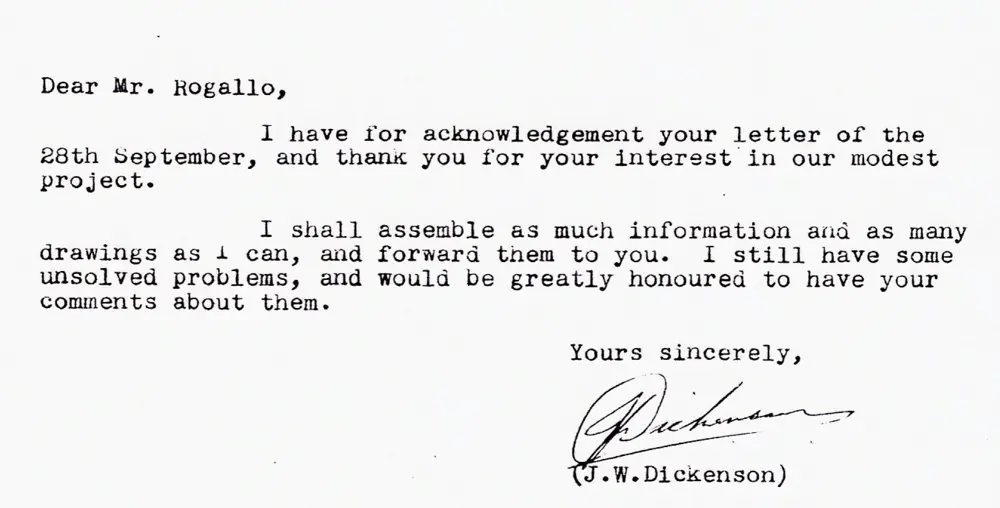
Dickenson – October 12, 1964
Dickenson acknowledges that he has received Rogallo’s request and will assemble as much information and drawings as possible. He would be “greatly honoured to have (Rogallo’s) comments about them”. (rdl-02)
Dickenson – November 24, 1964
Dickenson apologises for his delay in answering and for the crudeness of his design. He says he investigated other designs when he saw a picture of a Ryan research aircraft and adapted the wing shape to lift a water skier. He describes his invention precisely and in detail, how it is constructed and controlled, how it is flown in towed flight and free glides. “It is pleasant to fly and not really fatiguing.” He attaches ten pages of plans.
He trusts that “the photographs and drawings, along with (his) description, will give (Rogallo) a clear idea of the device”. (rdl-03)
Rogallo – January 29, 1965
Rogallo thanks Dickenson for what he sent. He hopes “to make copies of your drawings and perhaps have some individual or groups build a glider like yours locally”. He is considering buying one from Dickenson if he goes into production and would be glad to help find a market for it in his area. He concludes with his interest in having any further information. (rdl-04)
Dickenson – February 9, 1965
Dickenson asks for copies of the original drawings he sent to Rogallo. He does not intend to manufacture his “device”. He doesn’t have the finances or facilities. His “interesting project on fairly original work (is) motivated by a lifelong passion to fly, and not to go in the ski kite marketing business. Furthermore, such a market would be very limited.” He then analyses wing sizes and flyability and wants to “squeeze every ounce of efficiency out of the present glider.” (rdl-05)
Rogallo – December 17, 1965
Rogallo admits not having done anything about Dickenson’s ski kite design. He states that he flew in a Tom Purcell Flightsail glider mounted on a pair of floats, towed by a boat, with a “conventional stick for pitch and roll control”. He found it “a more complicated, expensive and cumbersome glider than yours”. He enclosed some notes with information about the “completely flexible glider” that NASA is developing and “that may have some sport value”. (rdl-06)
The “completely flexible glider” is the two-lobe parasail, researched by NASA from 1961.
Dickenson – January 17, 1966
Dickenson says that he has built only one wing in almost a year.
He is interested in Rogallo’s notes on cylindrical wings. He has tried a “locally made device” similar to Purcell Flightsail. (rdl-07)
Dickenson is talking about the Mike Burns/Aerostructures, Skiplane. (doc-18)
Rogallo – December 1966
Rogallo sends copies of Dickenson’s original drawings. He shares NASA’s progress on the “completely flexible wing” dropped from planes. “We have not yet tried initiating flights by running down hills or by towing”. (rdl-08)
David Barish’s first flight from the Catskill Mountains slopes with his “Sailwing” took place in September 1965. (doc-19)
Rogallo – December 1966
For his Christmas greetings, Rogallo sends a picture of his daughter “flying in one of our wings in front of our cottage in Kitty Hawk, North Carolina… I have also flown on this wing in the sea breeze.” The picture shows a two-lobe parasail, some 20 feet high, tethered on a beach. (rdl-09)
Dickenson – November 17, 1969
Dickenson reports on his work on a “powered Flex wing”. He has built two Bensen-type (gyrocopter) airframes and intends to use a basic ski kite configuration for further work with two Yamaha motors. He hasn’t flown the ski wing “due to foul weather and a nasty bout of pneumonia. However a Mr. Bill Moyes has developed a great deal of competence, achieving a height of 3,000 feet while being towed and entering free gliding flights almost every weekend. He has also managed to jump off a hill and sustained soaring flight in the slope lift for a period of some 15 minutes. His very many safe flights have confirmed the airworthiness stability and ease of control of this device.” (rdl-10)
Rogallo – January 1, 1970
Rogallo comments on Barry Hill Palmer’s motorised, small flexible-wing airplane. He then mentions the Ryan Aircraft designs, noting that they are much larger than Dickenson’s. He encloses “a copy of a newspaper announcement of a demonstration of your ski wing near Washington”. Unfortunately, he missed it. (rdl-11)
Did Rogallo ever share Dickenson’s plans with NASA or anyone else? If he did, we found no evidence to indicate that he did.
The big question raised by these letters is why the so-called father of hang gliding had the plans of the best hang glider ever invented (as he will admit later in another letter to Dickenson) and:
- Why Rogallo did not share them professionally with NASA, with all of its human and financial resources?
For someone who has been presented as having convinced NASA that the flexible wing was a fantastic project, why did Rogallo wait eight years to share the existence of the Dicken-son hang glider with NASA?
Rogallo revealed the Dickenson Glider to NASA in his 1972 presentation, Flexible Wings for Transportation. By then, it was being flown by hundreds of pilots in many countries. Rogallo omitted to credit Dickenson. Instead, he referred to “Barry Hill Palmer and others” for having “made flexible wings” and having begun “gliding down the Californian hill”. He underlined that Dave Kilbourne was the pilot flying the modern hang glider and cited Faust’s Low & Slow for the pictures. We will analyse this presentation at the end of this chapter.
- Why Rogallo did not share the plans with those pioneers who were trying to build hang gliders?
In 1964, Rogallo was in touch with “Barry Hill Palmer and others” (ana-10). He could have easily put them in touch with Dickenson, just as Bishop had put Rogallo in touch with Dickenson. If Rogallo had shared the Dickenson Glider plans, if Palmer and others had been in contact with Dickenson, history would have been very different. Rogallo could have done this simple thing that any decent person interested in promoting hang gliding would have done. He did not.
- Why Rogallo did not build, or have someone build for him, the easiest aircraft to copy that had ever been invented? He could have flown one in the same way that he and his family flew a parasail, on the beach, next to his home.
It could be that Rogallo was annoyed that Dickenson failed to call the Dickenson Glider a “Rogallo” in his correspondence. Especially when Rogallo, in his first letter to Dickenson, had included his Flexible Wing Research and Development presentation in which he claimed that “Paraglider, Parawing, Flexikite, Flex-wing, Flight-sail, etc., or more broadly, the flexible-wing concept are all Rogallo Wings”.
Rogallo must have realised that the Dickenson Glider would accelerate progress and greatly improve safety. If he did not, that speaks volumes against his vaunted stature. If he did, the only thing that explains his failure to share is a desire to conceal that someone else had invented the thing he spent a good part of his life dreaming about, yet profoundly and embarrassingly failed to achieve.
While Rogallo was hiding the existence of the Dickenson hang glider from everyone, a new sport was being built in Australia. Pilots were doing thousands of tow-and-release flights; they took off from mountains, soared ridges, and never pronounced or wrote once the words “Flexible Kite” or “Rogallo Wing”. They didn’t know that Rogallo existed.