
At NASA 1964-1972Research Switches to Parasails
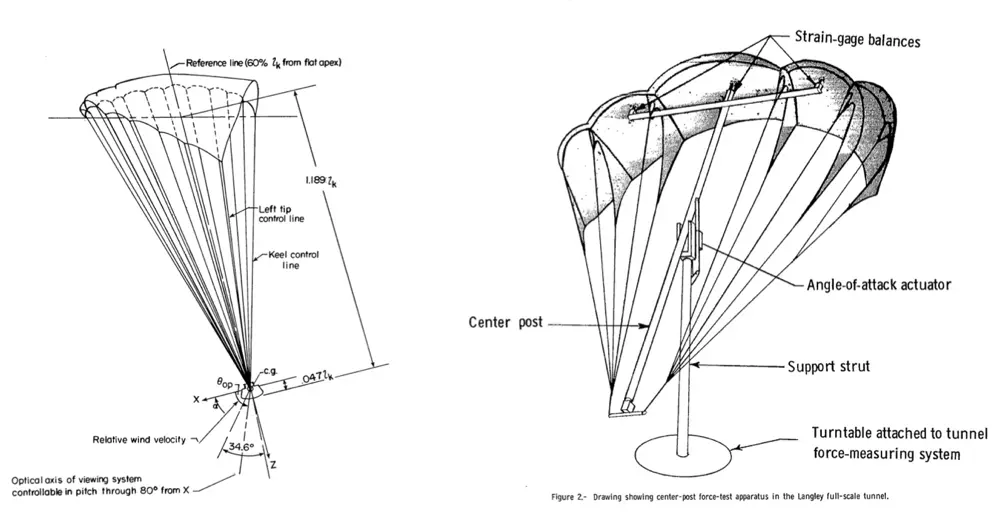
In the previous chapter, we saw how the steerable gliding parachute idea is an old one, as shown by patents dated as far back as 1924. In the 1960s, at NASA, these gliding parachutes had many names: all-flexible parawings, tension structure parawings, single keel parawings, twin keel parawings, limp paragliders, para-foils, sail-wings, and parasails. When we had the choice, we called them parasails.
Research on parasails started in 1961, and in 1963, NASA was wondering if the parasails would be a better solution than the parawing. By mid-1964, the Paraglider Development Program was removed from the Gemini Program and survived only a few months at NASA and North American Aviation for data-gathering purposes. The research on parawings slowed down considerably and switched to parasails.
We found the first illustrations of parasails in Rogallo, Sleeman, and Croom 1965 Résumé of Recent Parawing Research, referred to as “limp paraglider”. (rre-07) They have two conical lobes.
NASA Reports
Between 1967 and 1971, we found 25 reports electronically published by NASA. (ana-07)[/p]- Wind-tunnel tests of a series of parachutes designed for controllable gliding flight – May 1967 – 42 pages.
- Wind-tunnel investigation of the static aerodynamic characteristics of an 18-foot all-flexible parawing – June 1967 – 38 pages.
- Low-speed wind-tunnel investigation of tension-structure parawings – June 1967 – 192 pages.
- Low-speed test of an all-flexible parawing for landing a lifting-body spacecraft – June 1967 – 35 pages.
- Wind-tunnel investigation of the static aerodynamic characteristics of a multi-lobe gliding parachute – July 1968 – 24 pages.
- Investigation of opening characteristics of an all-flexible parawing – February 1969 – 33 pages.
- Fixed-base visual simulation of pilot-controlled descents of an advanced Apollo spacecraft with an all-flexible parawing – March 1969 – 63 pages.
- Experimental verification of scale factors for parawing opening characteristics with dimensional ratios from 1:1.3 to 1:3 – March 1969 – 43 pages.
- Wind-tunnel investigation of the aerodynamic characteristics of a twin-keel parawing – May 1969 – 32 pages.
- Wind tunnel and free-flight investigation of all-flexible parawings – June 1969 – 214 pages.
- Gliding parachutes for land recovery of space vehicles – September 1969 – 39 pages.
- Free-flight investigation of large all-flexible parawings and performance comparison with small parawings. Final report – March 1970 – 302 pages.
- Wind-tunnel investigation of several large-scale all-flexible parawings – March 1970 – 43 pages.
- Performance and deployment characteristics of a twin-keel parawing with various amounts and permeability of porous material in outer lobes – May 1970 – 41 pages.
- Determination of inflated shape and inertial properties of an all-flexible parawing – July 1970 – 34 pages.
- Aerodynamic and deployment characteristics of single-keel solid and single-keel slotted personnel parawings – July 1970 – 38 pages.
- Fixed-base visual simulation of obstacle avoidance during terminal descent of advanced Apollo spacecraft with an all-flexible parawing – August 1970 – 52 pages.
- Model wind tunnel and flight investigation of a parawing lifting body landing system – October 1970 – 95 pages.
- Low-speed wind-tunnel investigation of a series of twin-keel all-flexible parawings – October 1970 – 87 pages.
- Wind tunnel studies of effects of construction methods design details and canopy slots on the aerodynamic characteristics of small-scale all-flexible parawings – October 1970 – 94 pages.
- Low-speed wind-tunnel investigation of all-flexible twin-keel tension-structure parawings – October 1970 – 87 pages.
- An exploratory aerodynamic and structural investigation of all-flexible parawings – December 1970 – 189 pages.
- Aerodynamic and deployment characteristics of multistage canopy and suspension-line reefing systems for a twin-keel all-flexible parawing – July 1971 – 65 pages.
- Geometric aerodynamic and kinematic characteristics of two twin keel parawings during deployment – August 1971 – 70 pages.
- Deployment loads data from a free flight investigation of all-flexible parawings having 371.612 sq. meters (4000 sq. feet) of wing area – November 1971 – 512 pages.
Twenty-two reports come from NASA Research Centers in Virginia, Texas, and California. Three reports come from contractors in California and Washington, D.C.
The parasails have 2, 3, 4, or 5 lobes. (ana-08) They are one of the evolutions of the gliding parachutes and don’t look remotely like Rogallo’s patented flexible kites or Flexikites.
Rogallo was not involved in the parasail research or publications. None of these reports are from Rogallo. Out of 150 references found, Rogallo’s publications are cited only four times.
Little of value came from NASA’s parasail research.
Domina T. Jalbert’s Patents
We did not conduct extensive research on parasail patents, but these two are essential to understanding today’s reality.
- Multi-Cell Glide Canopy Parachute – Filed January 10, 1963 – D.C. Jalbert – US 3,131,894. To provide a parachute in which the under side of the canopy is provided with a plurality of cells which are open at the bottom and which communicate at their upper ends with longitudinal airflow channels located under the canopy and having air outlets or vents at the rear end of the parachute. (pin-20)
Jalbert’s invention is a triangular multi-cell and ram-air wing. Six cells; the air escapes through the back of two of the cells.
- Multi-cell Wing Type Aerial Device – Filed October 1, 1964 – D.C. Jalbert – US 3,285,546. To provide a wing having a flexible canopy constituting an upper skin and with a plurality of longitudinally extending ribs forming in effect a wing corresponding to an airplane wing airfoil and with the ribs providing longitudinal channels for the flow of air from a relatively large opening on the front of the wing and a restricted opening upon the rear of the Wing for the escape of air and with connecting means upon the lower skin to which shroud lines are connected. (pin-24)
Jalbert is the assignor for the Space Recovery Centre, Inc., Palm Beach, Florida. The wing is now a rectangular wing airfoil. It still has six cells; the air escapes through each cell’s narrowed trailing edge opening.
These patents destroy the claims that modern parachutes, paragliders, and kitesurfing wings are part of Rogallo’s legacy. The inventor of modern parachutes, paragliders, and kitesurfing wings is Domina Jalbert.
In the next chapter, we will examine these claims further.