
At NASA 1958-1964Rogallo’s Contribution — The Patents
To understand Rogallo’s contribution to aircraft design, we examined his patents.
- Jet Aircraft Configuration – May 6, 1959 – F. M. Rogallo et al. – US 2,991,961. The invention relates to a jet-augmented flap system for aircraft. (rpa-04)
Of no relevance to flexible or membrane wings.
- Flexible Wing Vehicle Configurations – April 29, 1963 – F. M. Rogallo – US 3,185,412. The invention relates to flexible wing vehicle configurations that are to a degree collapsible to facilitate launch into an extra planetary spatial vacuum, the vehicle thereafter being separable to form wing surfaces capable of reentering the vehicle into an atmosphere and landing on it on a planetary body. (rpa-05)
Many configurations are shown, mostly delta-shaped and bi-conical. All wings are heavily rigidified. There is no relationship with the modern hang glider pilot’s “planetary spatial reality”. The patent Examiner doesn’t cite Rogallo’s flexible kite patents as a reference.
- Flexible Wing Vehicle Configurations – April 29, 1963 – F. M. Rogallo – US 3,194,514. A division of (the previous) application. (rpa-06)
Same as above.
- Flexible Wing Vehicle Configurations – April 29, 1963 – F. M. Rogallo – US 3,197,158. A division of (previous) application. (rpa-07)
Same as above.
- Target Kite – January 23, 1963 – F. M. Rogallo – US 3,296,617. This invention relates to a kite with a self-supporting, airborne, electromagnetic wave corner reflector… A radar reflector that is self-sustaining. (rpa-08)[/p]
Of no relevance to flexible wings.
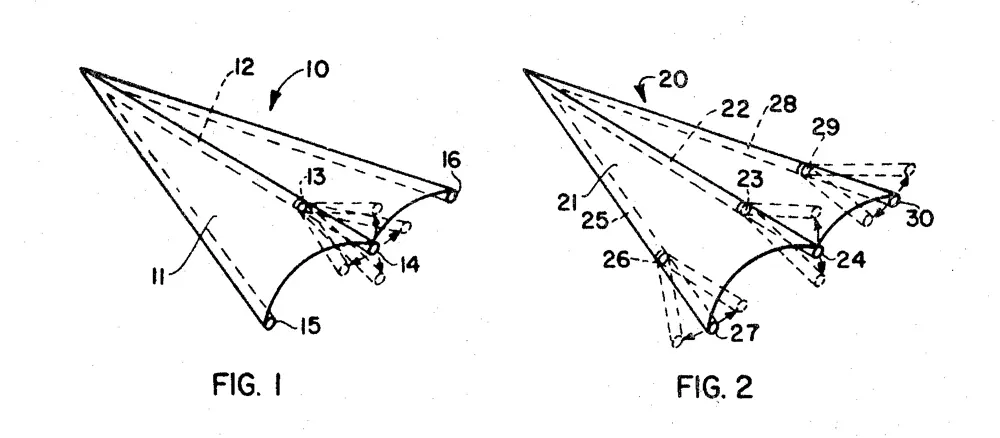
- Control Devices for Flexible Wing Aircraft – January 17, 1964 – F. M. Rogallo – US 3,396,921. This is a control device for a flexible wing aircraft (which) has a triangular shaped superstructure which includes a central keel member and leading edge members connected to the apex of the keel. The members are made of flexible material enabling flexure of the members to change the planform of the wing. The invention relates to control devices wherein the wing configuration is altered to provide control. (rpa-09)
The invention is about the control devices, not the triangular-shaped structure. Lee & Darrah patent US 989,786 (pin-02) for a bi-conical wing is referenced in this patent.
- Control Devices for Flexible Wing Aircraft – January 17, 1964 – F. M. Rogallo – US 3,423,049. A division of application for patent 3,396,921. The leading edge members are moved symmetrically or asymmetrically by a motivation mechanism to change the wing platform and thereby control the flight of the vehicle. (rpa-10)
It’s the same as above. The Lee & Darrah patent is again referenced.
- Control Devices for Flexible Wing Aircraft – January 17, 1964 – F. M. Rogallo – US 3,423,050. A division of application for patent US 3,396,921. The leading edge members are rotated by appropriate mechanism to present a variable-shaped surface to the airstream, and also change the wing platform to control the vehicle. (rpa-11)
Same as above, without the Lee & Darrah patent being referenced.
- Control Devices for Flexible Wing Aircraft – January 17, 1964 – F. M. Rogallo – US 3,429,529. A division of application for patent US 3,396,921. Spreader bars are positioned between the keel and leading edge members. They have an airfoil shaped design and are rotatable with respect to the keel and leading edge members. Mechanism is attached to the airfoil-like spreader bars to rotate them and provide control for the vehicle. (rpa-12)
Same as above.
- Control Devices for Flexible Wing Aircraft – January 17, 1964 – F. M. Rogallo – US 3,446,458. A division of application for patent US 3,396,921. The leading edge members and keel have a portion thereof joined. Mechanism is provided to move the jointed portion which changes the wing plan for providing control for the vehicle. (rpa-13)
Same as above.
- Control Devices for Flexible Wing Aircraft – January 17, 1964 – F. M. Rogallo – US 3,458,162. A division of application for patent 3,396,921. A flexible membrane-like material is fixed to the keel and leading edge members to form wing panels and a lift surface. This control entails hinging a portion of the keel to the aircraft. The keel is moved by motivation mechanism to change the wing platform and thereby control the flight of the vehicle. (rpa-14)
Same as above.
- Control Devices for Flexible Wing Aircraft – January 17, 1964 – F. M. Rogallo – US 3,460,784. A division of application for patent US 3,396,921. Apertures are formed in the membrane-like material in the trailing edge area of the vehicle. Covers are provided for the apertures, an actuator being attached to the cover to open and close the apertures. The opening and closing of the apertures spoil the airflow over the wing panels providing a means for controlling the vehicle. (rpa-15)
Same as above. Domina Jalbert’s patent US 3,131,894 for his multicell canopy is referenced.
- Control Devices for Flexible Wing Aircraft – January 17, 1964 – F. M. Rogallo – US 3,464,652. A division of application for patent US 3,396,921. Mechanism is placed in the leading edge members, the keel, or in the membrane-like material intermediate the leading edge members and keel to take in or gather up a portion of the wing membrane and thereby change the wing platform providing control of vehicle. (rpa-16)
Same as above. Neither Lee & Darrah nor Jalbert are referenced.
- Control for Flexible Parawing – January 17, 1964 – F. M. Rogallo – US 3,310,261. The invention relates to the control of a boltrope control for a flexible wing aircraft. To date, the principal technique of control is to shift the centre of gravity of the payload in respect to the flexible wing surface. It has been found to have many disadvantages… due to the weight and complexity of the mechanism necessary to accomplish the shift. The use of the boltrope control overcomes many of the above difficulties. (rpa-17)
The wing is triangular, bi-conical and rigid-framed.
Out of these 14 patents, two have no connection to parawings or parasails. Two concern the deployment of flexible wings in space. Nine concern control devices for “flexible wing aircraft”, but none of the wings are flexible. These parawing designs developed by NASA, the Department of Defense, and their contractors show keel, leading edges, and added spars made in metal or inflated composite material tubes. We know that all paraglider prototypes developed by NASA, the Department of Defense, and their contractors had deployment problems. They never managed to invent an adequate control system for any of them. These Rogallo patents, if used on them, would have only added weight and complexity. We are unaware if these patents were tested, used, and reduced to practice.