
At NASA 1958-1964Rogallo’s Contribution — The Publications
To understand Rogallo’s contribution to NASA projects, we looked for Rogallo’s publications.
- Flexible Reentry Gliders – April 5–8, 1960 – F. M. Rogallo, J. G. Lowry. For a presentation at the SAE National Aeronautic Meeting in New York. (rre-03)
We could not find the whole text, only extracts. We found the presentation titled and described in different ways.
Flexible Reentry Gliders. SAE Natl. Aero. Meeting, New York, Apr. 5–8, 1960. Presentation of some results of preliminary investigations of flexible gliders that are thought to have several areas of application in aeronautics and space flight, including their possible use as re-entry gliders. The glider discussed is a flexible aerodynamic surface which is essentially a tension structure of very light weight per unit of area.
Flexible Re-Entry Gliders for Bringing Astronaut to Earth Unscorched. Based on Life-boats for Astronauts. Preprint SAE 1750, Society of Automotive Engineers. SAE Journal, July 1960.
The presentation to the Society of Automotive Engineers was published in the association’s magazine. It is not cited in the references of any other of Rogallo’s NASA reports. The first lines state:
This paper will present some results of preliminary investigations of flexible gliders that are thought to have several areas of application in aeronautics and space flights. An artist’s conception of such a glider is shown.
- Preliminary Investigation of a Paraglider – August 1960 – Technical Note D-443 – Francis M. Rogallo, John G. Lowry, Delvin R. Croom and Robert T. Taylor. (rre-04)
The introduction states:
Current studies of vehicles to put a man in space and return him safely emphasise the need for a recovery device that has a low weight and small area during the launching phase, low acceleration and temperature during the reentry phase, and the stability control and performance required to glide to a predetermined site, and make a safe landing at a low or moderate speed.
The first author of this paper, Francis M. Rogallo, has for several years been experimenting with a flexible-lifting-surface concept that promises to satisfy many and possibly all of the aforementioned requirements.
Then follows: General description of a paraglider – Reentry calculations – Experimental studies.
The glider is called a “flexible wing”. But how flexible is it?
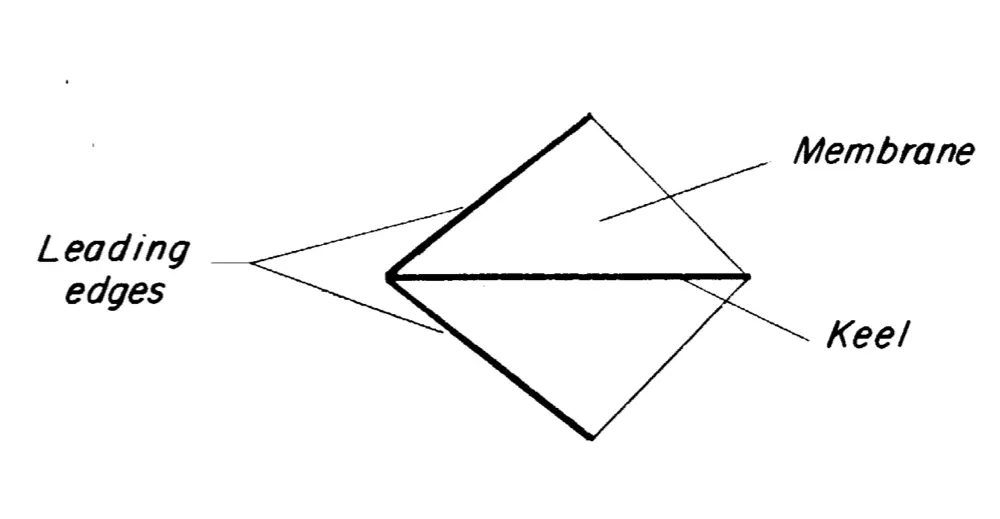
The glider as initially conceived was to be constructed of a wire gauze coated with a high-temperature silicone sealant with inflatable shroud lines and leading edges. For most of the experimental studies, the glider was constructed with rigid leading edges and keel. This type of construction was used because it simulated the inflated leading edges and keel without the difficulties associated with inflated structures.
One model was constructed of 0.016-inch-sheet aluminium alloy and was supported along its streamwise diagonal by a rigid (angle-iron) member.
- Paraglider Recovery System – April 30 – May 2, 1962 – Francis M. Rogallo - Presented at the Institute of the Aerospace Sciences meeting on Man’s Progress in the Conquest of Space, in Saint-Louis, Missouri.
We did not find any download for this document.
This “Conference Paper” is referenced in other NASA reports. The NASA Technical Report Server, says:
In 1945, it occurred to the writer that if we could discover how to make flexible wings that could be packaged and deployed somewhat like a parachute, such wings would have many new applications as well as replacing some parachutes and rigid wings.
Previous uses of flexible materials in aerodynamic surfaces – parachutes, kites, boat sails and wind mills – were reviewed, and some crude experiments were performed with gliders and kites.
Before the end of 1948, the device now generally called a paraglider was evolved and developed sufficiently to merit a patent application. The study was continued privately as time permitted, and in 1954 a short paper on the subject was presented to an audience of about 50 Reserve Air Force officers. This paper was given rather wide distribution, although it suffers from lack of the many kite and glider demonstrations of the original presentation.
Little serious interest was shown by the aeronautical community, however, until about a year after Sputnik I. In December 1958 the flexible-wing concept was presented to the Langley Committee on General Aerodynamics with the aid of the hurriedly prepared charts, faithfully reproduced here for historical purposes. ([doc]rre-02[/doc])
- Flexible Wing Research and Development – November 13–14, 1962 – Technical Note L-3242 – Francis M. Rogallo. For presentation at the Symposium on Retardation and Recovery, in Dayton, Ohio. (rre-05)
In his introduction, Rogallo presents the claims that:
- “Paraglider”, “Parawing”, “Flexikite”, “Flex-wing”, “Flight-sail”, etc., or more broadly, the flexible-wing concept” are all “Rogallo Wings”.
- “Other configurations” also “fall within the flexible wing concept”, hence are “Rogallo Wings”.
- The “two-lobe” current designs being researched by NASA, the Department of Defense, and their contractors were only “arbitrarily chosen for a beginning”.
Rogallo then summarises the current research and development: the 50-foot inflated-frame paraglider, the NASA Flight Research Center manned paraglider, the Gemini paraglider, the inflated micrometeoroid paraglider, the Ryan Flex-Wing and Fleep, the Marine reconnaissance drone, the individual drop and precision cargo drop, and the tow gliders.
Rogallo then describes the parawing lift-to-drag ratio versus the lift coefficient, stability and control issues, packaging and deployment issues, and materials used.
His statements are illustrated with photos and drawings of the craft in flight, on the ground, in wind tunnels, with artists’ drawn impressions of what could be built in the future, and with one graphic.
The “concluding remarks” evoke “the many other applications that have come to our attention”, and the call to join this “new, important and fascinating field of aerospace research”.
None of the models shown have flexible wings. They all have membranes that are rigidified by a metallic or inflated structure.
In the following sub-chapter, we will examine Rogallo’s claim that everything should be called a Rogallo Wing.
- Parawings for Astronautics – September 10–12, 1963 – Technical memorandum X-51047 – F. M. Rogallo. Presented at the Specialist Meeting on Space Rendezvous, Rescue and Recovery. Edward Air Force Base, California. (rre-06)
This presentation comes 10 months after his Flexible Wing Research and Development, in which he claims that the term “Rogallo Wing” applies to “the Paraglider, Parawing, Flexikite, Flight-Sail, etc., or more broadly, the flexible-wing concept”.
Most of the text is devoted to himself, his supposed inventions, his presentations, and his role in the history of parawings. Rogallo’s impossible-to-patent Flexikite, never studied by NASA, is forcefully lumped with the designs researched. We’ve copied his words in other chapters.
Then, there are generalities on the astronautical applications, the advantages, the configurations, the structures, and the materials used in the parawings.
The lifting surfaces of parawings are flexible membranes of relatively large curvature. Performance and other functional characteristics can generally be improved, however, by the judicious addition of local stiffening. Stiffening is generally found in the frame to which the membrane is attached.
Generally found? This is an understatement. The devices he is talking about are systematically rigidified by either a metallic or an inflated structure.