
At NASA 1958-1964Patents of Interest — Paraglider Development Program
We found these patents of interest relating to the Paraglider Development Program.
Flexible Wing Patents
- Flexible Wing Aircraft – Filed November 27, 1964 – J. E. Forehand – US 3,275,271. I claim: In an inflatable flexible wing glider comprising a central keel and a pair of lateral spars all of inflatable tubular construction, and a flexible membrane secured to said keel and said spars, a load carrier, shroud lines suspending said load carrier from said keel and said spars, and control lines extending from said load carrier to corresponding ends of said spars for controlling the flight path of the glider by bending said spars. (pin-21)
Forehand is an assignor for the Army. The keels and leading edges are inflated to make them rigid. Forehand claims they are flexible enough for control by bending. There is no reference to Rogallo.
- Flexible Wing Vehicle – Filed July 1, 1966 – Horace L. Woodlief Jr. – US 3,384,329. Construction features of a flexible wing gliding vehicle comprising three inflatable flexible booms forming a rigidifiable trifurcated frame and a fabric sail between the booms. (pin-27)
Woodlief is an assignor for the North American Rockwell Corporation. The patent references Rogallo’s patent: Control for Flexible Parawing – Filed January 17, 1964, – 3,310,261. (rpa-09)
Whether referring to Rogallo’s name or patent, or not, these two "flexible wings" are typical parawings with rigid structures holding flexible membranes. They have no connection with Rogallos’ kites.
We are unaware if any of these patents were tested, used and reduced to practice.
Ryan’s Patents
We found nine patents from assignors for Ryan Aeronautical Company.
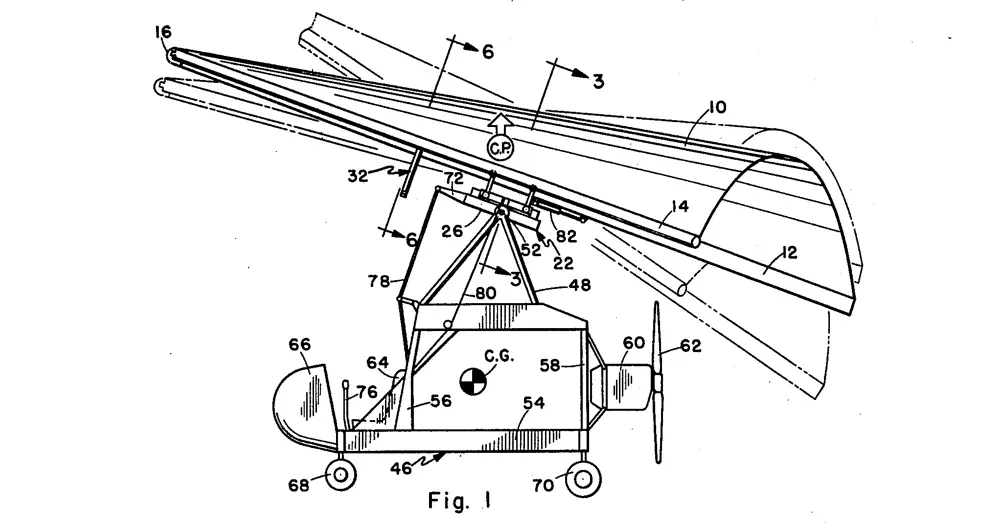
- Flexible Wing Aircraft – Filed March 17, 1961 – C. E. Craigo, H. A. James and Leo J. Hand – US 3,140,842. To provide an aircraft in which structural weight is minimised by using a flexible wing held in extended flight position by a minimum of rigid structure, the wing being foldable when not in use to reduce the required storage space, the airframe structure being pivotally suspended from the wing and control being effected by shifting the aircraft centre of gravity relative to the wing’s centre of pressure. The control system is functionally similar to conventional systems. (The aircraft) can be powered by conventional propulsion units. (pin-14)
This looks like the Ryan Fleep, but we don’t know if this patent was used. The control system to shift the center of gravity is quite complex—an understatement—compared to the one Dickenson invented for the modern hang glider and shared with Rogallo three years later.
- Auxiliary Boom Control System for Rogallo Type Wing Aircraft – Filed August 20, 1962 – P. F. Girard – US 3,135,483. Provide a control system wherein auxiliary booms are incorporated into the wing adjacent to the tip and used to change the effective angle of attack of the tip portion of the wing and thereby control the aircraft. (pin-15)
It’s referred to as a “Rogallo Type”, but Rogallo is not referenced: the difference between linguistics and reality. Rogallo will file a similar-looking patent a year and a half later, in his January 1964 patent US 3,396,921, Control Devices for Flexible Wing Aircraft. (rpa-09)
- Flexible Wing STOL Assist System for Aircraft – Filed December 26, 1962 – P. F. Girard – US 3,135,482. To provide a system to shorten the space required for taking-off and landing of an aircraft by using an auxiliary wing which is extended for take-off and landing and retracted into the aircraft when not in use. (pin-16)
Rogallo speculated about similar designs, Girard did it without referencing Rogallo. (STOL stands for Short Take Off and Landing.)
- Method of packing and deploying a foldable wing – Filed May 6, 1963 – J. E. Fink – US 3,198,458. The invention is to provide a method for deploying a folded Rogallo type wing or parawing into fully open position without danger of entangling the supporting suspension lines. When the wing is opened, the keel and leading edge members are substantially rigid and provide longitudinal stiffness. (pin-18)
Fink is an assignor for Ryan Aeronautical Co. He gives two names to his foldable wing: Rogallo and parawing. But the wing is rigid-framed in flight, hence, Rogallo’s patents for flexible kites do not apply.
- Roll Control System for Flexible Wing Aircraft – Filed November 4, 1963 – P. F. Girard – US 3,306,559. Provide a control system wherein small portions of the flexible wing are made controllable, causing an aerodynamic unbalanced which results in or assists the directional control of the aircraft. (pin-19)
A complicated way to control roll.
- Flexible Wing with Pitch Stabilizating Means – Filed June 26, 1964 – P. F. Girard – US 3,269,674. To provide a flexible wing having a separated forward wing portion forming a slotted configuration which acts to prevent a negative pitching action at low or zero lift conditions. (pin-22)
A “canard” addition in the shape of a delta wing to avoid negative pitching conditions.
- Flexible Wing with Integrated Tail Unit – Filed October 5, 1964 – P. F. Girard – US 3,223,361. To provide a flexible wing having a tail unit integral with the basic wing structure and including movable pitch control surfaces which are effective at all times and prevent occurrence of the negative pitching condition. (pin-23)
A V-tail addition to avoid negative pitching conditions.
- Demountable Aircraft With Flexible Wing – Filed March 7, 1966 – P. F. Girard et Al. – US 3,361,388. The aircraft is a lightweight minimal structure aircraft with a foldable flexible wing and an airframe which can be quickly dismantled, without tools, into units easily handled by one person and of a size which facilitates passage through a small opening, such as the hatch of a submarine or aircraft. A very simple control system is incorporated into the airframe in a manner which is adapted to the demountable structure, yet maintains its alignment during dismantling and reassembly, the assembly being also possible by one person without tools. (pin-25)
This looks like some of today’s motorised ultralight gliders, except that the control system, supposedly “very simple”, is not simple, with a canard wing and many moving parts.
The patent was filed in March 1966. Fifteen months earlier, Rogallo had received from Dickenson the plans and instructions for the modern hang glider, including its simple pendulum weight-shift control system. Ryan and NASA (and others) could have benefited if Rogallo had shared Dickenson’s invention with them.
- Flexible Wing Aerial Delivery System – Filed July 25, 1966 – P. F. Girard – US 3,381,919. Relate to a flexible wing aerial delivery system by which a payload may be air-dropped and flown to a predetermined landing site with considerable accuracy. The wing structure is self erecting upon dropping, without requiring any source of power or special services. (pin-26)
The wing structure is metallic and not in the shape usually seen in the Paraglider Research Project. The “abstract of the disclosure” explains the downside of using the usual “hollow flexible supporting members which are inflated by air pressure to extend and rigidize the structure”.
Reading the introduction to these patents is interesting as they detail the problems Ryan’s engineers had with getting the right amount of control and stability in their aircraft.
We are unaware if these patents were tested, used, and reduced to practice.
In their descriptions, two patents refer to “Rogallo-type wings” and one to his first kite patent, but none of these patents, in their references cited by the author or the examiner, list any of Rogallo’s patents or NASA reports. It shows that most people at Ryan and the patent examiners never believed Rogallo’s story that everything was a Rogallo Wing.
Rogallo will pose proudly next to scale models of parawings and parasails as if they are his babies. But they never were. (ana-06)