
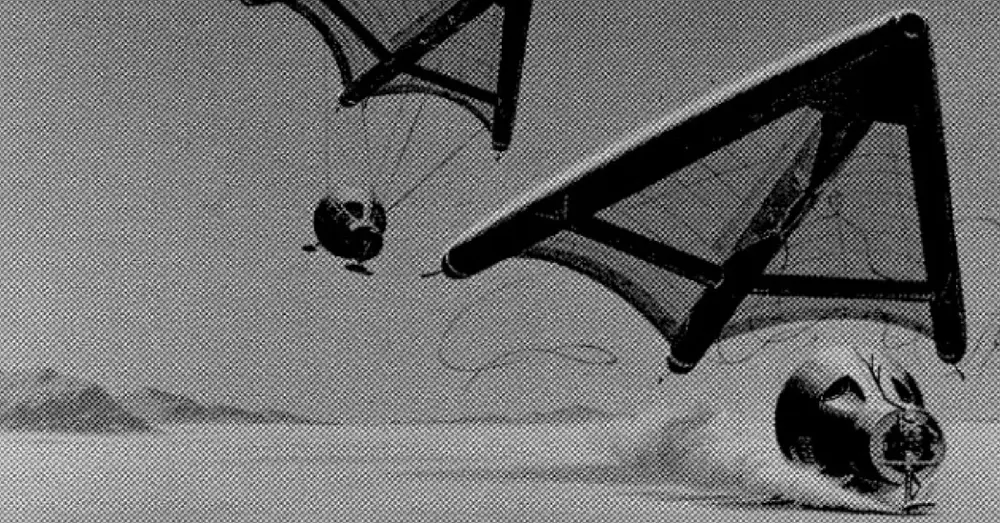
At NASA 1958-1964The Paraglider Development Program
In May 1961, the studies by the NASA research centers, and by the contractors received a new name: Phase I of the Paraglider Development Program. By mid-August, Phase I appeared to prove the feasibility of the concept for the recovery of manned spacecraft.
In Phase II, North American Aviation was to study the design concept—a bi-conical rigid-framed parawing—, decide what configuration would provide the best performance, build a prototype landing system, conduct flight tests, and complete a final design (ana-02)
Phase III would see a parawing in production with pilots being trained to fly it.
The Paraglider Development Program was controversial. Some defended the concept, others had serious doubts.
The key question was whether the deployment reliability of a single parawing would equal that of a main and back-up chute system. Paraglider critics found plenty of ammunition in North American Aviation’s slow progress towards a working system.
In 1962, North American Aviation was joined by McDonnell Aircraft Corporation. Failures followed successes. The delays, errors, and malfunctions were symptomatic of a lingering malaise.
The problems persisted even after it was decided that the parawing’s inflated wings would be deployed before they left the ground. In September, the paraglider research was raised to the status of a major program. Still, a fully successful flight test had yet to be performed. It was finally done in October: the parawing was stable in free flight. The next step was to deploy the wing in flight.
The tests were disappointing. Vehicles got wrecked. In March 1963, testing came to an abrupt halt. In May, it was decided to test each phase separately before trying to demonstrate a complete flight from deployment through landing. By the fall, the status of parawings was once more in jeopardy, challenged by advocates of what seemed to be a viable alternative, an all-flexible gliding parachute, the parasail. (ana-03)
Parawings vs. Parasails
The parasail had first competed with the parawing design in 1961, when it was decided to study a land-landing. Rejected then, the concept persisted as the subject of a modest research and development program at the Manned Spacecraft Center in Houston, Texas. As parawings faltered, parasails seemed more attractive. They matched conventional parachutes closely enough to provide quick and relatively cheap development. The Manned Spacecraft Center asked McDonnell Aircraft Corporation to study changing Gemini’s landing system from parawings to parasails.
In September 1963, when McDonnell finished its study, the issue was carried to NASA Headquarters. It was rejected. Discarding parawings with nothing to show for all the time, money, and effort already spent was out of the question. And there wasn’t enough money to support both the parawing and the parasail projects.
The End of the Program
Tests of the full-scale vehicle began in January 1964. They failed. The risk that loomed so large was perhaps not so much a land landing as a parawing landing. In April, the fifth failure in a row was the last straw. NASA was informed that the money would be transferred to other programs. Against this confluence of forces—technical, operational, and budgetary—the Paraglider Development Program could not survive. It was dead as far as Gemini was concerned, although a public statement of its demise waited until August.
“To Hell With It”
From Robert F. Thompson in his interview by Kevin M. Rusnak on August 29, 2000, for the Johnson Space Center Oral History Project. (doc-14)
“What we want is a great big boom on the front that will assure that we got a leading edge like the leading edge of a wing. So now I’ve got to fold up a great big hunk of heavy canvas called a leading edge boom. I’ve got to throw that out and I’ve got to have a bottle that’ll blow this big balloon up on the leading edge. Then I’ve got to pull all these drag lines out and rig them in such a way that I’ve got this semi-rigid wing over the thing.
‘The next thing you know, when you get through doing that for six months or a year with a bunch of engineers and so forth, you’ve got so much claptrap, it won’t work, basically. It gets too complicated. It gets too heavy. The sequence is not forgiving. You know, you jump out with a parachute, you’ve got to throw a bunch of cloth out there, but the air will go up there and inflate that cloth, and it’d work 999 times out of 1000, which is very reliable. But when you have to throw out a bunch of stuff, and unfold a bunch of stuff, and inflate a bunch of stuff, and pull out a bunch of lines, and have those lines on controls and so forth, it gets to be very complicated.
‘As that paraglider began to try to be developed, it just got more complex and got heavier and less reliable. The longer we went, the heavier it got and the less reliable it got. The leading-edge boom got bigger and heavier. It began to look like you weren’t going to get out enough lift over drag, so you’d be coming down more vertically than gliding. How to attenuate the force when you hit the runway, because it wasn’t practical to put a bunch of oleo struts and landing gears on the spacecraft? So the more we worked on the (parawing), the worse it got. ‘After eighteen months, two years, $27 million, whatever was finally spent back then, it was decided, to hell with it, we’ll just go ahead and put a parachute system on it like Mercury and use the landing procedures that we had.”
Fleep and Flex Bee
Three parawings received most of the media attention: the Fleep and Flex Bee (ana-04), and the Paresev (ana-05).
There are many pictures of the two versions of the XV-8 “Fleep” and of the smaller “Flex Bee”. They were published in many magazines, specialised or not, in the early 1960s. The Ryan Aeronautical Company developed these aircraft for the US Army and Air Force (not NASA). The Fleep and the Flex Bee were tested in the Langley wind tunnels, but were designed and flown in California.
The magazine Aviation Week and Space Technology , June 5, 1961, published an article titled Rogallo Wing Studied for Combat Mission. The article claimed that “the concept was invented by Francis M. Rogallo of NASA”, but Ryan’s project engineer, Cecil Craigo, told Aviation Week that “much of the data used in the design of the experimental Flex-Wing airplane was obtained about 80 years ago in pioneer glider flights by Otto Lilienthal in Germany.” Craigo, in his explanations on structure, wing fabric, control system, and experimentation, will refer again to Lilienthal, and never to Rogallo. (doc-04)
The magazine Flight International , August 1, 1963, asked T. Claude Ryan to outline the origin of the idea for the delta bi-conical membrane wing. He replied: “I guess this Flex-Wing concept was originally toyed with by Leonardo da Vinci—it seems he had a hand in every revolutionary concept. There is also evidence that Otto Lilienthal had a hang glider concept which was close to the Flex-Wing idea.” Still, after this acknowledgement, Ryan stated that "the modern man credited with the wing (was) Francis Rogallo."
The Fleep evolved from a four-wheeled vertical-fin aircraft to a three-wheeled V-tail aircraft. Limited control was an issue. The project went nowhere, despite artists’ impressions of many visions suggesting a bright future for the project.
The Paresev
Some engineers and pilots believed that NASA needed to acquire baseline experience before attempting to develop and fly the paraglider on a returning spacecraft. The best way to get that experience was by building and flying a paraglider. In December 1961, they approached Paul Bickle, director of NASA’s Research Center in Edwards, California. Bickle called in a group of engineers and gave his instructions: build a single-seat paraglider, do it quickly, and cheaply. The team set to work on the Paraglider Research Vehicle, conveniently abbreviated Paresev.
Seven weeks later, the team rolled out the Paresev I. Flight testing started immediately. The Paresev was difficult to fly because its center of weight was so far below its center of gravity. During a ground tow, it developed a rocking motion that got worse until it entered a wing-over and crashed into the lake bed, demolishing the device and injuring the pilot. The accident ended the days of the Paresev I.
A Paresev I-A was built, with a conventional stick and rudder control system, and a smaller sail. Ground towing quickly indicated this paraglider handled better than its predecessor, and NASA moved to flight tests. Planes towed it to 3,000 meters before release. It underwent one further modification, as the Paresev I-B, equipped with an inflatable Gemini-type paraglider wing. Originally scheduled as a two-month flight test project, the program became interesting enough to keep the program running for two years. Eventually, engineers created an almost usable aircraft, with almost acceptable handling characteristics.
The use of the paraglider for returning spacecraft to dry land was abandoned, so the Paresev was never needed.
Not Rogallos
The Fleep, Flex Bee, and Paresev were not designed in Langley, where Rogallo was working. They had no engineering, aerodynamic, or design connection to the Rogallo patents. None of the patents related to their designs cited Rogallo in their references.