
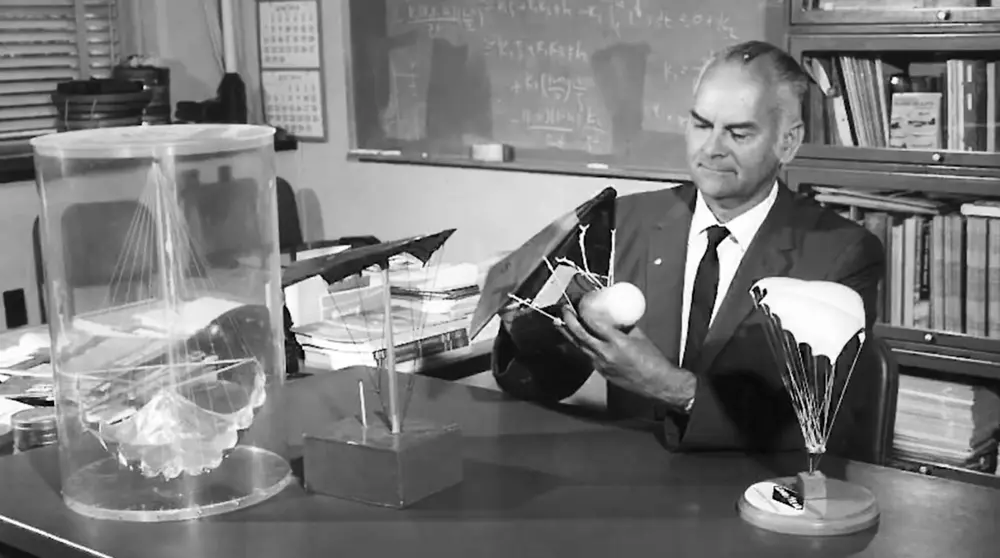
At NASA 1958-1964Rogallo at NASA
According to Francis Rogallo: In Parawing for Astronautics , a 1963 presentation to the Specialist Meeting on Space Rendez-Vous, Rescue and Recovery. (rre-06)
The launching of Sputnik 1 seemed to shock the aeronautical research community to such an extend that it began to consider many unconventional ideas seriously. The parawing was one. Shortly after NASA was formed in 1958, we began to make a few crude wind tunnels and model flight investigations of parawings in the 7 by 10-foot Tunnels Branch. Gradually, people in other divisions became interested and volunteered to investigate parawings in their facilities.
During 1959, cloth parawings were tested in the 4-foot supersonic wind tunnel at Mach 2 and others we deployed at high altitude (150 to 200 thousand feet) at Mach numbers near three. In August, Dr. von Braun invited me to give a presentation to some of his people. Business was picking up.
In April 1960, a paper entitled Flexible Reentry Gliders was given to the SAE National Aeronautic Meeting. Also in the spring of 1960, parawing briefings were given at Ryan and North American Aviation at their request. Both companies began company-funded studies. Before the end of 1960, Ryan had begun building the powered man-carrying Flex-Wing at their own expenses.
In the January of 1961, I presented a parawing talk at the IAS meeting in New York and in March repeated it in Lancaster and San Diego, California. While in San Diego, I witnessed the first flight of the Ryan Flex-Wing.
Early in 1961, the Marshall Space Flight Center gave Ryan and the North American Aviation contracts to study the feasibility of recovering Saturn C2 booster by means of parawings. NASA in-house investigations were also made. These studies indicated that recovery of the C-2 was feasible and the recovery program would have been continued if the C-2 had not been cancelled.
The first parawing contract let by the Department of Defense was to Ryan for flight tests of the Flex-Wing. The aircraft was sent to Langley for investigation in the full-scale tunnel. It looked like parawings were here to stay.
Thereafter, the numbers of projects and contracts increased. Many of the flight articles are shown in the NASA film Serial n° L-805 entitled Paraglider Recovery Systems.
By the summer of 1963, it appeared that the concept had achieved world-wide acceptance and that the time had come for (me and Gertrude) to give the government royalty-free license for the use of our patents, which we did in a ceremony in Washington on July 18, 1963.
According to David Barish
In 2010, in Hang Gliding & Paragliding, the United States Hang Gliding and Paragliding Association’s (USPHA) magazine, Steve Roti published an interview of David Barish, The Probable Inventor of the Paraglider. Excerpts:
Q . “What was your educational background that led you to develop the Sail Wing?”
A . “I earned masters and professional degrees in Aeronautical Engineering from Cal Tech. I spent nine years in the Air Force as a pilot. After the Air Force, the first parachute I worked on was the vortex ring parachute from 1954 to 1957. In 1964, I really got going on the gliding parachute as a result of the work I was doing under contract for the Army.”
Q . “Is there anyone in particular that inspired you to pursue this form of aviation?”
A. “My own interest led me into the gliding parachute area. Of course, Lindberg inspired my whole generation.”
Q . “Were you aware of Francis Rogallo and the work he was doing?”
A . “Yes, I was, and after we got into the NASA work for the higher-performance version we did a lot of our wind tunnel testing at Langley where Rogallo was working. Our work started out quite differently because Rogallo was interested in using metallic structures and all my work was without rigid structures. While we were testing at Langley one day, I looked over my shoulder and saw Rogallo looking at the models we had hanging in the wind tunnel and taking notes. Of course, he followed quite a different path.” (doc-15)
Rogallo's NASA career
During his 12-year NASA career, Rogallo was the head of the 7 by 10-foot Tunnel Branch, Full-Scale Research Division, where he supervised testing models designed by others.
The Langley wind tunnels did the tests, but:[/p]- North American Aviation’s parawings were researched, built, and flown in California.
- Ryan Aircraft’s Fleep and Flex Bee were researched, built, and flown in California.
- The NASA’s Paresev was researched, built, and flown in California.
- The McDonnell Aircraft Corporation’s parasails were researched, built, and flown in Missouri.
- The NASA Manned Spacecraft Center’s parasails were researched, built, and flown in Texas.
Rogallo filed 18 patents: one for a flap system for jet aircraft; one for a target kite; three for deploying parawings in space; nine for controlling parawings; two for controlling parasails; two as a continuation of previous patents. Eighteen patents seems a lot for a single man, but we have found that there is no evidence that any of these patents were reduced to practice and no evidence that they had any influence on the parawing and parasail programs.