
At NASA 1958-1964Patents of Interest — 1903-1953
NASA’s designs were not connected to the Rogallos’ patented flexible kites. What inspired the engineers to research and develop their many parawings and parasails? Were they aware of Jan Lavezzari’s and Reinhold Platz’s designs? (bna-01). Anyone studying aviation at university could have been able to learn about them. By 1961, they were certainly aware of Lee and Darrah’s, and other patented designs for bi-conical kites and wings, plus the gliding parachute patents.
Early Kite Patents
- Kite – Filed July 30, 1903 – F. Lischtiak – US 743,301. (pin-01) A bird-shaped kite, simple in construction, to combine lightness, strength, and durability.
A central keel and wing-bars held by spars.
- Kite – Filed December 23, 1909 – H. P. Guillo – US 1,029,010. (pin-03) A knock-down kite capable of being readily taken to pieces and folded for transportation.
Foldable, rolled in a tube, 40 years before Rogallo’s Flexikite.
- Improvements in Kites – Filed January 10, 1923 – G. Denbigh – GB 213,981. (pin-04) Consists of two rods, one straight being of rigid nature, one curved flexible and tapered.
This kite had been popular across Asia for hundreds of years, where huge kite festivals involving kite fighting saw thousands of participants regularly. The sail is square. The rigidification makes it a good fighter kite; it is still widely used today.
- Self-Balancing Kite – Filed July 17, 1926 – C. Dalh – US 1,632,822. (pin-07) The purpose of this invention is to provide a kite of relatively, simple and economical string construction in which the parts are connected together with sufficient flexibility to permit an automatic adjustment to the wind pressure upon them for maintaining a proper balance so that the kite will fly steadily and without the use of a tail or other ballast.
The kite is rigid-framed with a “mid-rib and a cross-arm”. It has a bi-cylindrical section. It doesn’t need a tail like Rogallo’s models. They can be organised in groups piled above each other, much like is shown 22 years later in the first Rogallo Flexible Kite patent.
- Flying Wing Kite – Filed May 29, 1947 – R. F. Bach – US 2,463,135. (pin-11) Capable of captive or free flight. Flexible in performance, manipulated in the air to effect gliding and sailing.
Triangular, bi-conical, a central “fuselage,” and two leading edges, “wing spars”. Fuselage and spars can be made of wood for small-sized kites or metal for large-sized kites. Bach suggests using a synthetic film for the sail, something like the future Dupont Mylar.
This was one of the five patents referenced in the first rejection of Rogallo’s first Flexible Kite Patent (letter dated September 21, 1949). (bna-03) This is a known source for Rogallo to learn about bi-conical wings, and it looks like the inspiration for the Flexikite that he couldn’t get a patent for. Like the Flexikite and some paragliders, it lacked a crossbar, meaning the nose angle and billow could change in flight.
- Kite – Filed January 29, 1948[/b] – G. D. Wanner – US 2,537,560. (pin-12) Simple and inexpensive construction having superior flying qualities. Having a substantially flat flexible cover so supported that in flight a portion thereof assumes the form and function of a fixed rudder. The lateral portions of (cover) form a dihedral angle when the kite is in flight.
A square, bi-conical, and rigid-framed wing with a central “rod” connected to two “diverging” ones held in place by leading edge wires. Forgetting for the moment Jan Lavezzari’s 1904 glider, this patent, filed ten months before the Rogallo Flexible Kite patent, prevented anyone from ever claiming ownership of the bi-conical membrane wing used in the Fleep, Paresev, and the Dickenson Glider.
- Kite – Filed October 27, 1953 – W. Green – US 2,785,870. (pin-13) Includes diverging wing sticks, a body of sheet material, a cross stick and a U-shaped bracket affixed to each wing stick to receive the ends of the cross stick.
The diagrams in this patent are confusing, but there are plenty of photos of Green’s patented kites, which looked like an early modern hang glider.
The seven kites above are rigid-framed toys kept in their proper shape when flying by well-organised bridles. Their structure is somehow flexible. Only Bach describes larger models with a very rigid metallic structure.
Lischtiak (1903) and Green (1953) describe kites with the basic structure adopted in the 1960s: a central keel, two leading edges, and a cross bar supporting a bi-conical flexible wing.
None of these kites are totally flexible. They are, in this regard, like the parawings developed by NASA, the Department of Defense, and their contractors.
Early Conical Wing Patent
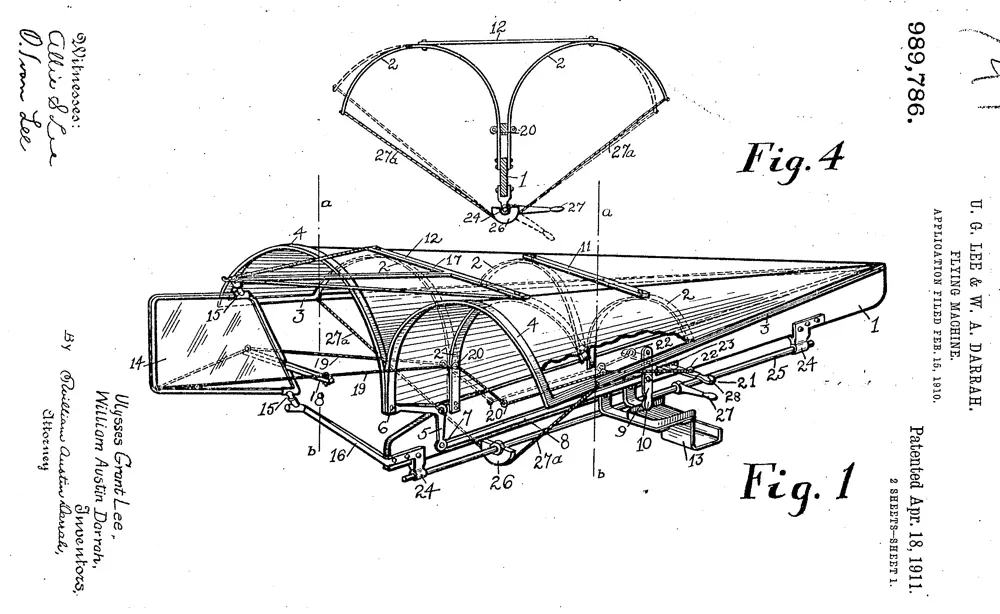
- Flying Machine – Filed February 15, 1910 – U. G. Lee and W. A. Darrah – US 989,786. (pin-02) To provide a supporting surface of such design that it will tend to return automatically to the normal position if temporarily displaced. To provide means for maintaining or regaining lateral stability. To provide means for directing the machine both vertically and horizontally.
The patent was filed in February 1910, six years after Jan Lavezzari’s flights in France on a bi-conical glider. All we know about the craft to date is what is in the patent. While there is no evidence of the aircraft being built or flown, the description indicates an accurate and detailed knowledge of the aerodynamic and stability characteristics of the bi-conical wing. This patent was referenced in the Ryan patent, filed on March 17, 1961, US 3,140,842, and some of Rogallo’s later patents.
Early Gliding Parachute Patents
Many inventors designed parachutes to be steerable and have gliding qualities. For instance:
- Steerable Gliding Parachute – Filed September 9, 1924 – Frantz Dudon – US 585,513. Allows the pilot to resist the action of the wind and head for the landing site. The essential characteristic of the aircraft lies in the layout of its rear section, which forms a true airframe fitted with rudders and elevators. (pin-05)
- Parachute – Filed December 9, 1924 – D. Hurlburt – US 1,685,422. A device to control the direction of the glide. A substantial plane elongated surface member is disposed horizontally beneath the parachute. Means are provided to tilt this surface member longitudinally. A slide slip or glide is thus produced, (providing) means for so manipulating the surface member to cause the parachute to turn in any desired direction. (pin-06)
- Parachute – Filed August 28, 1929 – E. L. Hoffman – US 1,780,190 – The provision of means by which the parachute may be controlled or steered and the direction of descent governed manually. The canopy is substantially triangular in shape, the one end of which is funnel-shaped whereby to vent the air laterally and propels the parachute in a horizontal direction. (pin-08)
- Parachute Apparatus – Filed July 19, 1937 – R. H. Hart – US 2,117,319 – Provide a parachute, the direction of which shall have a horizontal component being controllable at will. The canopy having venting means so contrived and arranged that there may be vented therefrom a more-or-less horizontal column of air by the person suspended from the canopy. (pin-09)
Parachute – Filed September 15, 1938 – J. Overbeke – US 2,258,797. Provide a keel thereby preventing uncontrolled turning and spinning and allowing a greater degree of control. Provide a conical or wedged shaped projection in the centre of the spread of material which will cut through the air as the parachute descent toward the ground and direct the flow of air. (pin-10)
In his 1972 presentation Flexible Wings for Transportation (rre-09-rogallo-stated-that-in-the-1950s--and-1960s--parachutes-were-modified-to-provide-some-forward-velocity-by-venting-air-from-the-rear-portion-of-the-canopy.-rogallo-is-off-by-at-least-30-years.-of-course-the-1950s-and-1960s-were-when-rogallo-invented-everything-flexible-as-he-claimed-in-his-1962-nasa-presentation-emflexible-wing-research-and-developmentem-docrre-05). For Rogallo, facts did not matter, in his mind everything started with him.
Parasails, limp paragliders, gliding parachutes, and all-flexible parawings… started being studied by NASA, the Department of Defense, and their contractors in the early 1960s, but they were developed in the middle and late 1960s after the Paraglider Development Program was terminated. We will develop this point in the next chapter.