
Building the MythRogallo and Dickenson Meet and Correspond
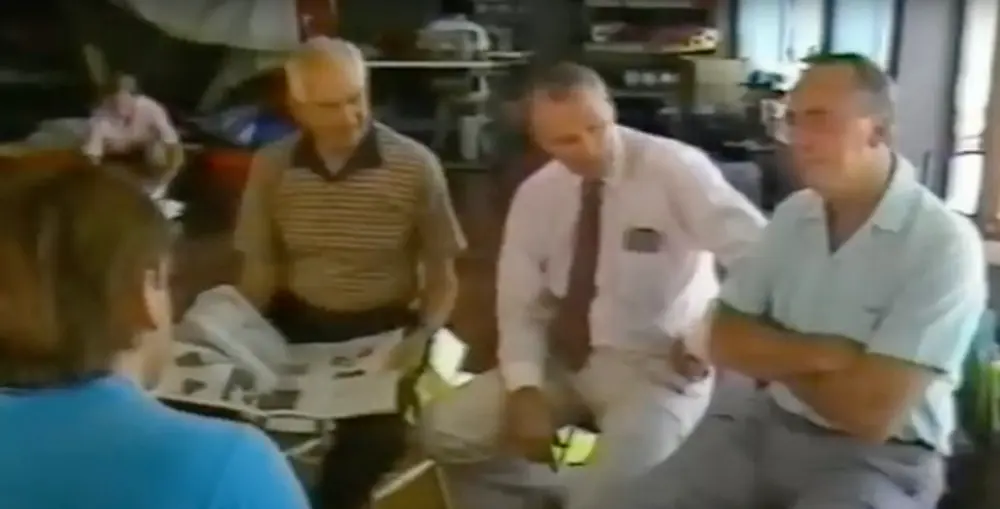
In 1988, the FAI 8th Hang Gliding World Championships were held in Mount Buffalo, New South Wales, Australia. The championships were organised by Bill Moyes, who invited Francis Rogallo to be the Guest of Honour. Bill also organised a filmed meeting with John Dickenson. It was the first and only time that Rogallo and Dickenson met. They were interviewed. They started a new short correspondence: four letters in six months.
The Interview
Adrian Swift interviewed Francis Rogallo, John Dickenson, and Bill Moyes for a documentary for Channel 9. Dickenson had only been invited that morning, while at work. He had also been told that morning that his job was being terminated, so he was completely off balance for the whole interview. The interview could have been the time to set the record straight, but it failed. (btm-18)
- The voice-over introduces Rogallo as the NASA scientist who first saw the possibilities of the flexible wings; Moyes as the man credited for the hang glider and for being the father of the sport; and Dickenson as the man who really did invent the hang glider.
- Rogallo is shown holding a bi-conical rigid-framed model and releasing it to glide. He describes his dream of a totally flexible, simple, unbreakable, easy-to-carry aircraft, and how he convinced NASA.
- We are told of Dickenson’s first attempts that “crashed horribly”, and of the successful flights that followed, with a glider that could free-fly back to earth. And of Moyes coming to Dickenson two years later.
- Moyes takes over and says that he was the first to fly the glider correctly and to free-fly it back to the ground. He says that in front of Dickenson, to Dickenson’s amazement. Moyes spins more tales that have nothing to do with reality, but he is a good storyteller, everybody laughs, though Dickenson’s laugh is hesitant. That Dickenson cooperated with Moyes on glider designs until 1973 is left out of the final cut.
- Dickenson credits Moyes as having seen the full potential of his wing and calls him the father of the sport of hang gliding. At the time, Dickenson had been under the impression that he took Moyes for his first flight and that Moyes was “a natural pilot.” Dickenson didn’t know that Moyes had already bought a copy of his glider and had been flying it for many months.
Dickenson was excited that Rogallo had used the term “Dickenson Wing”. Rogallo said it off-camera, though. This is the only occasion we know of Rogallo having used this term. On the sidelines of the interview, John told Francis that his glider had made him, Rogallo, famous. John said Francis did not look happy about the comment.
Dickenson faxed Adrian Swift at Channel 9, underlining: “The comments by Francis Rogallo concerning the ‘Dickenson Wing’ are important to me as his recognition of my technical achievement. Dr Rogallo had a PhD in aero-engineering, and also had the resources of NASA to do a lot of his testing. My qualification in aero-engineering is as an amateur. When you consider I developed this concept isolated and alone for an initial outlay of $50.00, the technical achievement is considerable. Rogallo has the education to appreciate and recognise this achievement.” (btm-19)
In his fax, Dickenson also pointed out some of Moyes’ lies: that he certainly knew how to fly his own glider, having broken endurance records with it before ever meeting Moyes.
Dickenson received no reply.
The Letters
Dickenson – July 11, 1988
John reminisces meeting with Rogallo: a “privilege”. He sends him pictures of the very first “public notice” of his glider. He explains the “mystery” of him “walking away from hang gliding” in 1973, and how he advised Moyes until then. He asks Rogallo to send him copies of their correspondence. (rdl-12)
Rogallo – August 23, 1988
Rogallo sends copies of the correspondence and enclose his 1962, 1968 and 1972 “papers”.
“As I stated in my enclosed Washington paper, Purcell had built towed gliders and Palmer had built foot-launched gliders in ’61 or ’62. However, the combination of flexible wing, control bar, and pilot suspension that you developed became the most popular.”Rogallo then explained how, in 1974, Peter Brock “gave (him) a wing from his factory. Consequently, I have been flying your glider design instead of continuing my development of fully flexible foot-launched gliders.” (rdl-13)
Rogallo – January 16, 1989
Rogallo remembers his time in Australia a year ago and sends his New Year’s greetings. Also…
"I often tell people of your valuable contribution to hang gliding, and if I write anything of the history, I will certainly include your part."
He refers to the December 1988 issue of the USPHA magazine and “a story about Bill Bennett in which he gives you some credit for getting him started”.
The article actually said that Dickenson modified Rogallo’s design, and that the new design was a Rogallo. The article also claimed that Dave Kilbourne was the first to foot-launch and soar. Dickenson’s and Moyes’ flights did not exist. To some people, things only happen when they happen in America. (rdl-14)
Dickenson – January 30, 1989
Dickenson now has his full correspondence with Rogallo, with drawings. He is explaining why he did not follow up on his patent. He refers to Bill Bennett trying “to obtain a patent in America for the Dickenson Wing. I usually don’t take much notice of rumours, but saw a copy of the application that Bill Moyes obtained. It was rejected as being a known invention. You are probably getting the picture that there was some very dirty work afoot from time to time.”
Dickenson believes that his contribution to the hang gliding movement is now recognised thanks to Rogallo’s acknowledgment of his work, and to an interview by Stéphane Malbos, “a journalist who has a dedication to getting it right… The mills of truth are slowly grinding on.” (rdl-15)
Dickenson had completely failed to grasp that Rogallo and Moyes, whom he regarded as being his friends, were chiefly responsible for him being denied due recognition.