
Building the MythWho Invented the Modern Paraglider Wing?
In his NASA 1962 Technical note on Flexible Wing Research and Development, Rogallo claimed that the “Paraglider, Parawing, Flexikite, Flex-wing, Flight-sail, etc., or more broadly, the flexible-wing concept” were all Rogallo Wings. He also claimed that “other configurations” not yet considered “fall within the flexible-wing concept”, hence will be Rogallo Wings.
It is no surprise that, when Domina Jalbert patented his multi-cell ram-air wing designs, Rogallo claimed that they were Rogallo’s. Hence, today, ram-air parachutes and paragliders are claimed to be part of Rogallo’s legacy.
In 1948, Rogallo described that his single surface, square, bi-cylindrical kite could be reinforced “at the centre line and also at the trailing and leading edges” with “hollow fabric tubes which are open at their front end and close at their rear end as to be inflatable by the incoming wind and maintained in shape hereby”. But this description was not a claim of the patent. Jalbert’s cells have a large opening at the front and a smaller opening at the back, an essential feature of the ram-air parachute. While they are still flexible, they are too stiff for the Rogallo Flexible Kite Patents. Jalbert’s patented parachute is a complex piece of equipment with very subtle design features that make it work. It is a far cry from Rogallo’s piece of cloth with bits of string attached. (btm-20)
Through the years, some people have repeated Rogallo’s claims that the modern parachute, paraglider, and kitesurfing wings are his legacy. Supported by nothing but Rogallo’s vain and dishonest claims. Those claims are an insult to Domina Jalbert, the original and true first inventor of today’s most popular man-carrying wing.
Domina Jalbert – 1904-1991
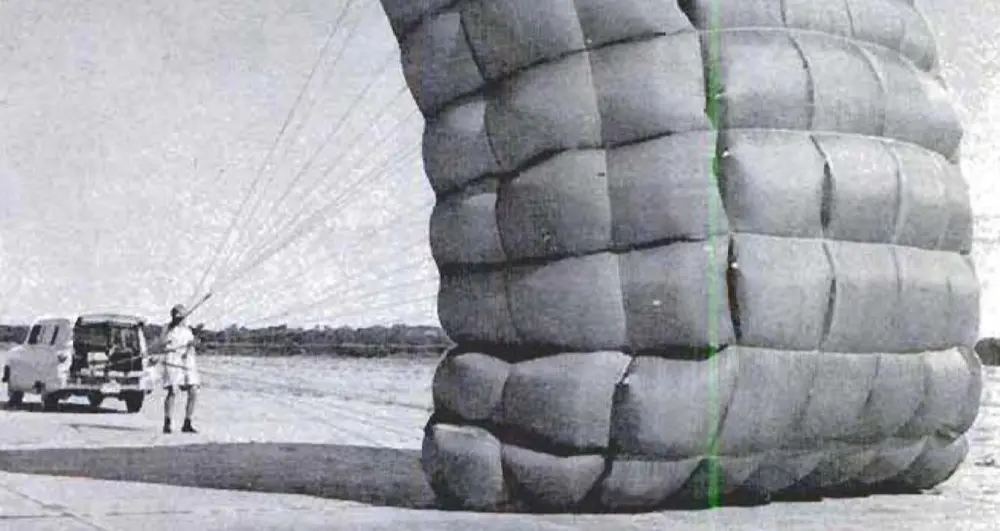
Domina Jalbert never worked for NASA. He was a specialist in kite balloons and patented a model in 1944. In the late 1950s, he tested square parachutes and multi-cell ram-air parachutes. (btm-21) In 1963, he filed a patent for a triangular parachute made only of inflated cells. In 1964, now as assignor to Space Recovery Center, Inc., Palm Beach, Florida, he filed for a patent on a Multi-cell Wing Type Aerial Device. It is this model that was briefly tested by researchers at NASA.
The Rogallos’ patented kites and Jalbert’s patented designs are completely different. The Rogallos’ is a thin, bi-cylindrical single-surface kite, (bna-05); Jalbert’s is a thick flat ram-air multi-cell airfoil. (pin-20) (pin-24)
Having imagined, but not patented, the possibility of inflated- tube reinforcements on keel and leading edges doesn’t make Rogallo the “original and true first inventor” of Jalbert’s multi-cell ram-air wings. Rogallo, instead of honouring Jalbert’s success, stole the credit.
Neither Jalbert nor the patent Examiner referenced Rogallo in the patent files. Jalbert’s work is innovative and original.
Rogallo also claimed that the two, three, or five-lobe parasails tested by NASA were his legacy. The claim is ludicrous. The parasails were developed as an evolution of the many gliding parachute designs created and patented since 1924. See Chapter 4 (At Nasa 1958-1970 – Patents of Interest).
Rogallo’s claims show the extent of his deception. Others who support Rogallo’s claims demonstrate their gullibility and/or deceit.
Low & Slow – 1972
In Low & Slow newsletter #11, the first issue of 1972, an undated letter from Francis Rogallo is published. It says:
A large number (about 20) patents related to flexible wings have been taken out in my name, solely or jointly with others. The patents apply to both stiffened and completely flexible wings. Many people are using our ideas, inventions, discoveries, or whatever one calls them, which is a satisfaction to us. Our first flexible wing patent states that rectangular or elliptic shapes may be used and that various forms of stiffening may be used, including ram air inflation. It is sometimes hard to distinguish between new design and new invention, even in the patent office.
NASA people have made a few exploratory tests of double-membrane, ram-inflated delta wings, and some with scoop inlets near the aft end of the wings.
I have noticed that the press regards every man who builds a home-built aircraft as an inventor, even if he has made no changes in someone else’s design. It must make a better story that way, and probably very few people really care about the origin of technology, only about its final application.
Rogallo’s kite and Jalbert’s wing have nothing in common. If people were to care about “the origin of the technology”, they should praise the many inventors of gliding parachutes. If they cared only about the final application, they should praise Jalbert.
DHV Info – 1989
In its December 1989 issue, DHV Info, the magazine of the German Federation, published A Brief History of Hang Gliding and Paragliding, written by Rogallo. (btm-23)
In the years since 1974, hang gliders have evolved into aircraft of much higher performance, but have also become complex and expensive, and demand more skill and training because of their ability to fly higher, faster, and farther than the older models. Perhaps it is this trend that has opened the door for popularisation of all-flexible wings such as those… stiffened by ram-inflated tubes, a modification we had proposed in our original flexible-wing patent.
Rogallo is delusional. His 1948 vision has no bearing on Domina Jalbert’s 1963 invention.
Rogallo – 1990
In the Charlie Jöst/DHV documentary, the Rogallos’ first flexible kite patent description is shown, with this underlined: “For example, rectangular and elliptical configurations may be used… The reinforcement may consist of hollow fabric tubes which are open at their front ends and closed at their rear ends so as to be inflatable by the oncoming wind and maintained in shape hereby.” The voice-over then says: “Francis Rogallo may be considered as the spiritual father of paragliding”. (btm-25)
Jalbert’s inflated tubes are completely different, with openings at both ends. The structure of Jalbert’s wing is a series of joined parallel tubes that form a double-surface wing. Compa-ring Rogallo’s concept to Jalbert’s is nonsense. Rogallo’s suggestion bears no similarity and never worked. Jalbert’s inflated tubes have more in common with windsocks than with any Rogallo patent.
The Rogallo Foundation – 2026
Today, on its website, The Rogallo Foundation states on its home page: “(Rogallo’s) innovations led to the development of hang gliding, paragliding, flexible wing ultralighting, parachuting, kiteboarding, and kiting”.
Their home page displays two video banners. One of a NASA parasail, and one of a modern paraglider. (btm-22)
In the Foundation’s Hall of Fame diploma and poster, there is a painting of Gertrude and Francis Rogallo next to their first flexible kite patent’s drawings and a picture of a modern paraglider. (btm-24)
Rogallo’s “innovations” led nowhere. When John Dickenson learned the truth about Rogallo, he smashed up his Rogallo Foundation Hall of Fame award and got Graeme Henderson to throw the debris into the rubbish bin.