
Building the MythHere and There
In the rest of the world, the myth kept growing. The disregard for historic facts, if only for a correct timeline, was impressive. The modern hang glider was just a Rogallo, maybe with a Bennett/Moyes control system. Dickenson was totally ignored. (btm-15)
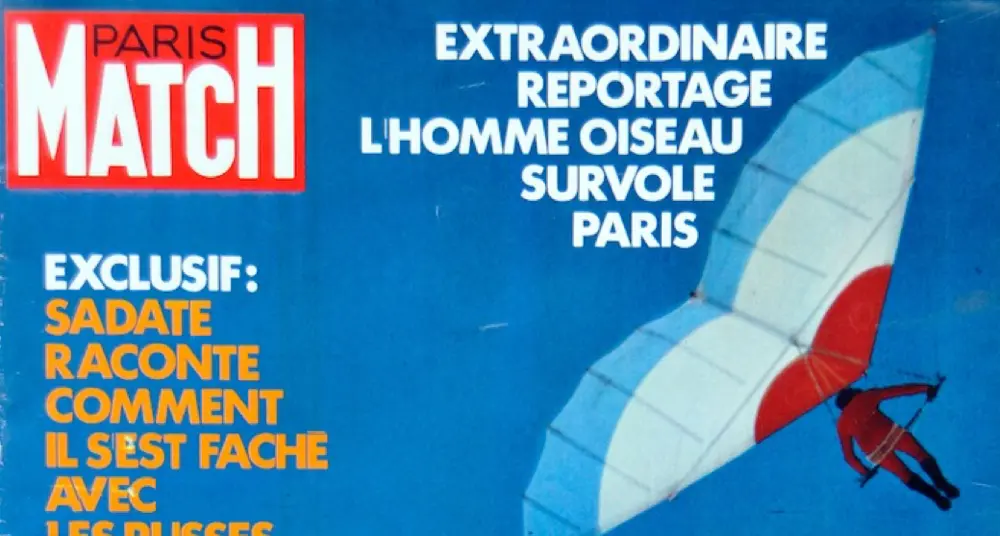
- Paris Match – France – 1972
This weekly is the French equivalent of the American Life magazine. In its August 12 issue, “Greek like Icarus, the Birdman who really flies”, Yannis Thomas is shown flying in Paris around the Tour Eiffel and Arc de Triomphe. How ones become a Birdman?
“In 1969, with the Australian Bill Moyes and based on the design of the aeronautical engineer Francis Rogallo, I developed my Delta Wing. The main innovation was the swing seat that allows controlling the A-frame and wing like a control stick.”
- Delta – Jean-Bernard Desfayes – Switzerland – 1974
“When, in 1948, he first filed for the patent that bears his name, Francis Melvin Rogallo was perhaps not aware that he was about to make a decisive contribution toward the realisation of one of the oldest dreams of mankind: that of flying. Flying with one’s own wings… Rogallo has upset hierarchy: he has given the skies to a legion of enthusiasts who previously could only look up at them with longing from below. He has revealed their true beauty to others who had only experienced it from within the narrow confines of a cockpit. He has made them accessible to those countless numbers hardly predisposed to emulate Icarus, but who, one day, in the California dunes or in the French or Swiss Alps, fell in love with his strange machine.
‘There is a direct relation between the American research of the early sixties and what is to be seen today, and it can easily be traced: Bill Moyes, an Australian, experimented with a reduced scale kite of the same type as those NASA had worked with in the United States. As opposed to other kites, those that Moyes experimented had the distinct advantage of being able to gain altitude regardless of the speed of the towing vehicle. At about the same time, an American, Richard Miller, built the Bamboo Butterfly, a Rogallo type wing made of bamboo and polyethylene that cost him nine dollars and many bruises and sprains… It was to be four years before the word was to spread beyond limited intimate circles or across the Pacific of the exploits of these two pioneers.
‘In April 1969, 116 years later, Moyes’ partner, Bill Bennett, once again carried out the mission of Cailey’s coachman; he was instructed to go to the United States to give demonstrations there with the craft invented by Moyes. During the American water-skiing Championships at Berkeley, Bennet was a resounding success. Three months later, on the fourth of July, Independence Day, he caused a sensation when, towed on his water skis near the Statue of Liberty, he flew over the monument and landed in the field at its feet.”
- Birdmen – Ken Messenger and Ronnie Pearson – Great Britain – 1976
“In the mid-sixties and early seventies came two separate contributions to the Birdman dream. The first of these was made by Richard Miller, who began certain novel experiments with a new type of parawing that had recently been patented by Rogallo, a research scientist working for the United States Government. Miller constructed a sample of the Rogallo wing with plastic for canopy, held permanently spread open in a semi-rigid, shallow-billowing delta shape by two leading edge spars, a keel spar and a cross boom under which were fixed Lilienthal-type parallel bars for the armpits.
‘Then in 1971 came an important contribution from the well-known Australian water skiers, Bill Bennett and Bill Moyes. For some years they had been parascending behind their speedboat tow lines suspended first under fully limp canopies and then under flat delta-shaped kites by a single rope with a piece of plywood at the end, which they put between their legs as a crude swing seat. Now, hearing of the Rogallo they were off to California eager to exchange knowledge and ideas. The result was an immediate gain for both sides of the Pacific. American Rogallo hang gliders got the Bennett/Moyes seat suitably developed for their purposes with a full flat board and two suspending ropes. This improved takeoff and landing technique, weight-shift control, and pilot comfort.”
- Hang Glider Pilot – Ann Welch and Gerry Breen – Great Britain – 1981
“Francis Rogallo started working for NASA in the forties and over the next few years filed some twenty patents, some jointly with his wife. In the sixties the new hang glider movement had its small beginnings, and inevitably some Rogallo-shaped wings were built along with copies of 1920 hang gliders and other interesting devices. In 1972, Francis Rogallo took out another patent, this time to get earthbound men airborne, instead of space capsules back to earth. Since then, the sport has never looked back.”
In Australia
Only Australia seems to have kept its head on its shoulders. Glenn Woodward got the story mostly right. (btm-16)
- Catch the Wind – Glenn Woodward – 1977
“In July 1963, Rogallo gave the United States Government the right to use twenty-five of his patents in return for a royalty fee. At about the same time, Australian engineer John Dickenson was independently developing his own versions of the delta wing. In 1963, in a kite made from Oregon, banana plastic, sticky tape and baling wire, Dickenson was towed aloft behind a ski-boat. A year later he had developed the delta form so successfully that rope releases and free flights had become a matter of course.
‘In the same year, Dickenson was granted a patent for ‘An Improved Gliding Apparatus’. This patent was a significant landmark in the development of the sport throughout the world, for it included the triangular ‘A’ frame or control bar which allowed the kite to be accurately manoeuvred about its center of gravity. The patent also incorporated the notion of free flight in a delta kite. These two major advances enabled hang gliding to progress as it has.
‘Dickenson continued his experiments until 1967 when he introduced two aspiring ‘birdmen’, Bill Moyes and Bill Bennett, to the delta kite. The history of hang gliding from that date is brief but one of rapid progress.”
Dickenson applied for a patent, but due to cost he did not complete the process, so it was not granted. (pin-17)