
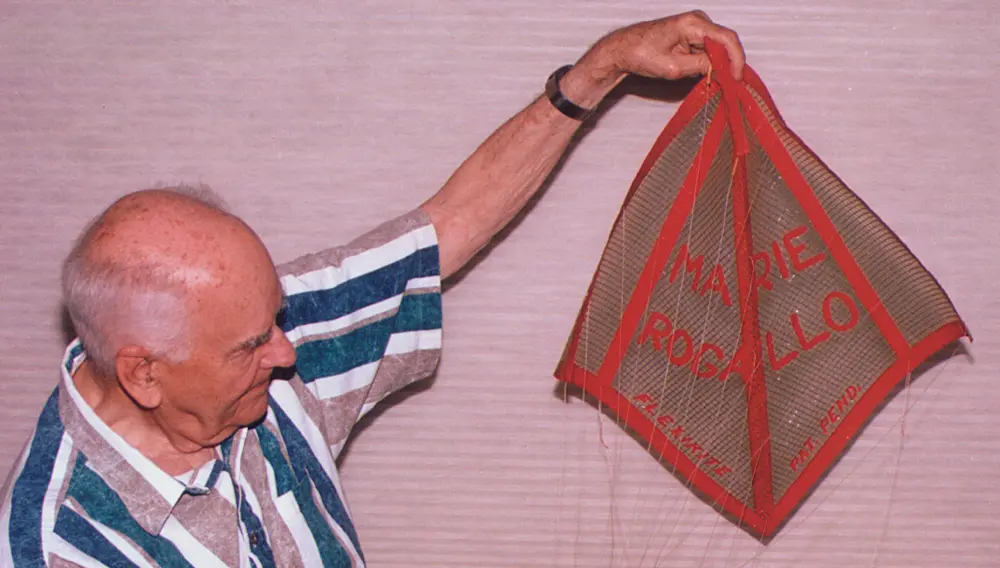
Before NASA 1912-19581948 — Rogallos’ First "Flexible Kite" Patent
According to Stéphane Malbos’ 1997 interviews and documents:
Hobbies often provide something lacking in our vocational work, and, fortunately, my family was as eager as I for the kiteflying that I suggested. With my wife Gertrude’s help, I made small models and tried to fly them as gliders and kites. We started by making small paper kites and dropping them as gliders. Then we attached threads to them at various points and towed them about the living room. When we found a promising configuration, we built a larger model made of cloth and took it to an open field.
Our efforts were not in vain, for after many attempts we succeeded in making one of our kites fly.
By the end of 1948, we had developed successful flexible wings and had flown them both as kites and as model gliders, and applied for patent number 2,546,078 for “a kite having completely flexible surface… having improved aerodynamic characteristics… of simple and economic construction… graceful in flight… which may be easily folded or rolled and requires a minimum of space in storage.
The patent
On November 23, 1948, the Rogallos filed their first patent application: G. S. Rogallo et Al. – US 2,546,078. (G.S. stands for Gertrude Sugden.)
On September 21, 1949, six out of the ten claims in Rogallo’s patent application were rejected (1, 2, 7, 8, 9 and 10). The rejections referred to Overbeke, Astle, Dahl, Guillo, and Bach’s previous work. (bna-03)
The reasons for the rejection are not easy to follow. It is important to remember that this is a discussion between the Rogallos, their patent attorney and the patent office. The rejection is a request for clarification. The best way to understand the rejection is to study the amendments and the referenced patents. The amendments do help to understand the limits of the patent.
For instance: “Astle’s pneumatic tubes are not yieldable in the sense applicant intends. It is clear from Astle’s drawing that his tubes are not supposed to bend or take an arcuate shape by virtue of wind pressure during flight. In fact, they are fully rigid members from an aerodynamic point of view. On the other end, applicant’s edge reinforcements are truly yieldable and intended to be flexible in flight so as to permit the proper arcuatness of the wings. Non-bending tubes would defeat applicant’s purpose.” (bna-04) The patent is then amended: “Claim 1 now states that the centre line is effected by a non-rigid crevice… It means in effect that the applicant’s kite does not have a centre stick.”
So the original claims were modified, nine claims were approved, and the patent was granted on March 20, 1951. (rpa-02)
Here is a summary:
- A body of flexible non-rigid material with winglike sections extending on both sides of a centre line created only by a crevice in the material.
- Bridles are attached to the wings and connected to the kite line. They set the in-flight angle of attack.
- The kite is quadrilateral. The bridles are secured to the edges of the wings.
- At least one bridle is secured to the centre line.
- A ribbon-like tail element is attached in the middle of the trailing edge.
- The bridle lines are attached at their end to apply an even tension to keep the kite in the proper shape during flight.
- The arcuate shape of each wing and the tension of the bridles allow the wind to lift the kite.
- There is a swivel joint between a pair of lines attached to the trailing edge of the wings and the ribbon-like material.
- The edges of the kite and the centre line may be reinforced with a flexible non-rigid material.
In other words…
The kite is a square of flexible material, specifically, paper or fabric, folded in two, diagonally. This diagonal crease gives rigidity to the kite. Bridles are attached to the kite to keep it in a bi-cylindrical form during flight. The leading edge and the trailing edge must have the same arcuate shape (the same curve). A ribbon tail is attached to give stability to the kite in flight. The only reinforcement allowed must be made of flexible material.
We have not seen any pictures of this kite. We found no evidence that it was demonstrated, commercialised or cloned: there is no evidence that the patented kite enjoyed any level of success. To get a photo of the Flexible Kite described in this patent, British hang glider pilot Mark Woodhams had to make one, to use in the article he wrote with Graeme Henderson, published in Skywings in 2010, Did We Really Fly Rogallo Wings? (doc-25)
He wrote: “As an experiment, I constructed a replica kite as close to the 1948 patent as I could. (bna-05) Mylar didn’t come available until 1953, so I used a plasticised shower curtain for the body of the kite, and Rogallo has mentioned this sort of material in some of his early documents. (Note. Later, Rogallo used Mylar for commercialising his Flexikite.) I followed the drawings and text of the original patent as closely as I could.
‘It was not a success. In low winds, it hung in the air with the front fairly distorted due to the material’s inability to resist the compression loads exerted longitudinally along the keel. I feel that Mylar might have been stiff enough to resist this buckling, or perhaps a heavier shower curtain would have had the same effect, but then how flexible is flexible?”
Woodhams then progressively stiffened the keel and the leading edges with thin wood dowels, a non-flexible material in the sense of Rogallo’s patent (“The applicant’s kite does not have a centre stick”). Still, he “certainly could not get it to perform very well”.
When the bridles were adjusted to make the kite bi-conical, the kite’s performance improved moderately. Of course, by then, “the kite design diverged completely from the original patent”.