
Before NASA 1912-1958The Visions
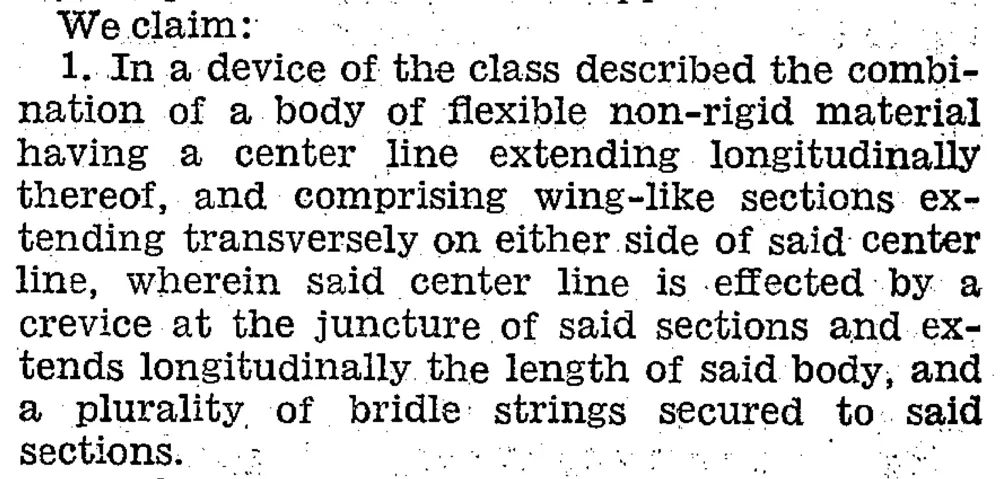
The First Patent – 1948
In the description:
"We have shown but one form of the kite. Other forms are entirely feasible. For example, elliptical configurations may be used… Reinforcement might conceivably be comprised of flexible material such as wood… Reinforcement may consist of hollow fabric tubes which are open at their front ends and close at their rear ends so as to be inflatable by the oncoming wind and maintained in shape hereby."
And in the conclusion of the description:
We believe the principle described herein may be applied to man-carrying devices, such as airplanes, parachutes and gliders, and in such event stabilising and control surfaces could be added.
We further believe that our principle could be utilised in the construction of a toy glider or airplane, and we have met experimental success by attaching a weight in place of the control string and reflexing the trailing edge by means of a piece of string between the two ends of the centre line. In this connection, it should be noted that whatever structure or framework for supporting weight, motor, etc., might be utilised in conjunction with our device, such structure would be hung from the kite body and not secured to it in any manner which would tend to make the lifting surface rigid.
An additional phase of utility of our invention would be the construction of the kite embodying our principle but made of metal foil, either to serve as an antenna or as a radar target.
It will be appreciated that our invention is subject to many modifications without departing from the spirit thereof, and we do not regard ourselves as limited to the specific illustration herein, except as set forth in the appended claims.
Ford Times – 1951
One of these days, we are going to make our kites large enough to lift a man, and supply him with controls which have already been developed on our small kites.
Mechanix Illustrated – 1952
One of these days, we’re going to make one of our kites large enough to lift a man. We’ll supply him with some controls. A further development would allow the kite to be flown as a glider. Imagine the thrill of carrying such a glider in your knapsack to the top of a mountain and then unfurling it and gliding down into the valley. But the most intriguing possibility is the use of this wing as the lifting component of an auto-airplane.
Introduction to Aeroflexibility – 1954
The four-string tailless kite may be converted into a glider if a load is attached to the loop in place of the flight line. Control is relatively simple: differential operation of the wing lines for lateral control and of the fore-and-aft lines for longitudinal control.
Essentially, this design could be scaled up to carry people or useful loads. Such a glider could be towed into the air or could be launched from a tower or any high point of ground, or it could be dropped from an aircraft. One might be able to soar with such a device. Propulsion could be provided by propellers, jets or flapping wings. The device could be used as a lifting component of flying automobiles or an auxiliary wing for an airplane.
We have flown almost every conceivable shape of flexible kites. Very clean flexible aircraft can be designed if loading is allowable at the wing tips as well as at the fuselage, as indicated by the accompanying sketches. Wing plan form and tail arrangements and means of propulsion are purposely not shown because many arrangements are possible and should be the subject of extensive investigation.
p] This discussion has purposely omitted mention of non-aircraft applications such as for the propulsion of boats, ice sleds or wheeled vehicles… I mention these other areas of application only to further illustrate the possible broad applications of the principles discussed.[/p]Address and Interviews
As compiled in And The World Could Fly.
Gertrude and I continued our research at home, and during the years 1948 to 1958 we developed a variety of flexible kites, some of which were marketed and publicised. Other kite designers and manufacturers introduced other variations, and the total effect was soon evident in the art, sport and technology of kites in America.
p] Wherever these flexible kites were flown, they attracted the attention and admiration of children and grown-up alike. One of these days, we were going to make a kite large enough to lift a man and supply him with some controls which had already been developed on our small kites. To test it in safety, we would probably tow it from a boat. If it proved successful over water, we could try it over land. A further development, already worked at with small models, would allow the kite to be flown as a glider. Imagine the thrill of carrying such a glider in your knapsack to the top of a hill or mountain and then unfurling it and gliding down into the valley. But the most intriguing possibility was the use of this non-rigid wing as a lifting component of a combination auto-airplane.[/p] p] Gertrude and I continued our research at home, and during the years 1948 to 1958 we developed a variety of flexible kites. Some of those wings were totally flexible, like future paragliders; others, semi-rigid, like future hang gliders. They were all triangular because it was the trend at that time, with the new delta-wing airplanes having a sharp backward sweep. I could not study everything! But our first patent was very clear: all kinds of shapes and make—rectangular, elliptic, single surface, cells— could be used, to make a flexible wing fly, as long as the suspension lines were spread correctly.[/p]