
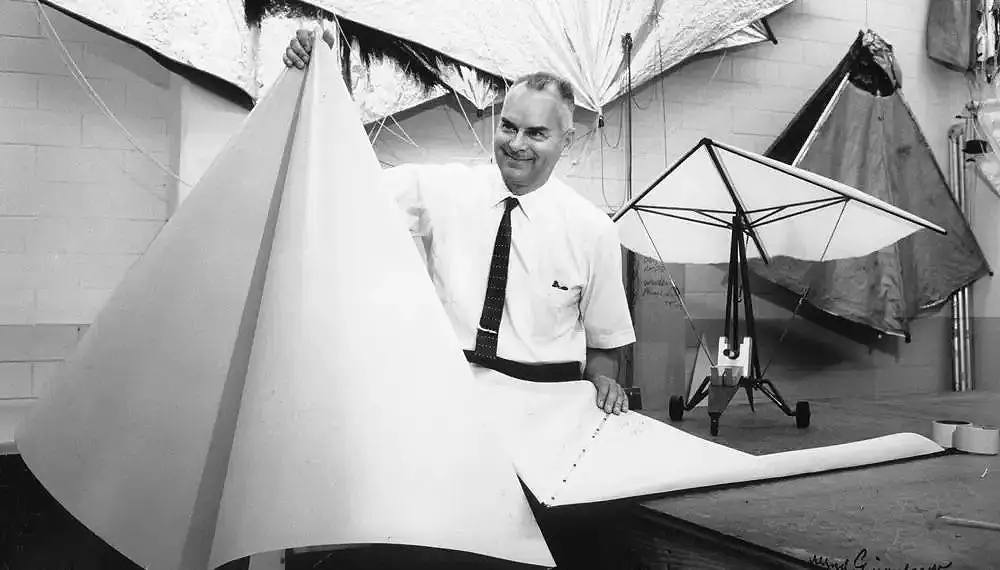
Before NASA 1912-1958The Deceptions
It is nice to have visions of flying, one of mankind’s oldest dreams. What matters is reality.
The crux of Rogallo’s deception was to mistake his visions for reality. The last paragraph of the previous subchapter tells it all.
- First, the candid acknowledgement: “I could not study everything !”
- Then the vision: “All kinds of shapes and make—rectangular, elliptic, single surface, cells—could be used, to make a flexible wing fly.”
- And then the deception: “Our first patent was very clear.”
Yes, the first patent was very clear. It was limited “as set forth in the appended claims”, and the claims were: Symmetrical in both span and chord, central crevice, no rigid material or reinforcement, the same arcuate shape in the leading and trailing edges: a bi-cylindrical wing.
In any patent, the description is not covered by the patent; only the claims define what the patent applies to.
A triangular bi-conical shape rigidified by an inflated tube or metallic structure could not be considered “as set forth in the appended claims”. Hence, Rogallo was not the inventor of the parawings.
A multi-lobed triangular bi-conical parachute could not be considered “as set forth in the appended claims”. Hence, Rogallo was not the inventor of the parasails.
A multi-cell ram-air parachute could not be considered “as set forth in the appended claims”. Hence, Rogallo was not the inventor of the modern parachute, paraglider, and kitesurfing wings.
Rogallo’s visions contain preposterous claims. Making his kites large enough to carry men or cargo? It never happened. Supply controls that the Rogallos had already developed? There is certainly no evidence of his patented control systems ever having worked. Controlling the parawings remained an unsolved challenge for the Paraglider Research Program.
It didn’t matter to Rogallo that many people before him had visions of man-carrying flying machines going back centuries, including the artist Leonardo da Vinci.
It didn’t matter if man-carrying rigid-framed membrane wings were flown successfully much earlier in the 20th century. Frenchman Jan Lavazzeri in 1904 and German Reinhold Platz in the 1920s′ came up with elegant designs. (bna-01)
Rogallo will claim in his 1962 NASA presentation, Flexible Wing Research and Development, that “Paraglider, Parawing, Flexikite, Flex-wing, Flight-Sail, etc., or more broadly, the flexible-wing concept” were all “Rogallo Wings”. (rre-05-and-later-nasa-would-claim-that-the-allison-flexible-kite-was-a-rogallo-wing doc-21[/doc])
Rogallo was not concerned with facts, or truth.