
Building the MythThe Elusive Curtain kites
The Curtain Kites tale is a good example of how Rogallo changed his storyline over the years – before, during, and after his stay at NASA – to perpetuate the myth that he is the father of everything, and how the myth took off from there. (btm-01)
We have no picture of the curtain kites before 1974, when one of its versions was introduced as “the original model of the flexible wing”. We looked back in time to understand where this particular kite came from. Our comments are below each bullet point.
- In his March 1951 article for Ford Times, Rogallo writes:
We started by making small paper kites and dropping them as gliders. When we found a promising configuration, we built a larger model of cloth… Our efforts were not in vain, for after many attempts we succeeded in making one of our kites fly. After that taste of success, … many shapes and materials were tested until we had developed a thoroughly satisfactory model. (doc-01)
The “thoroughly satisfactory model” should have been the bi-cylindrical kite that the Rogallos patented (US 2,546,078). But we are not aware that this kite was ever demonstrated. In the article, Rogallo is shown working on the Doplex Flexikite. This kite was supposedly sold at F.A.O. Schwarz in New York, carrying a Patent Pending notice. It was never patented.
- In his 1954 presentation, Introduction to Aeroflexibility, Rogallo writes:
It was possible to do a lot of exploratory work in the evenings and on weekends. Some of the results of that work, done as a hobby during the past six years, are the basis of this discussion. Our first models were made of cloth and looked something like parachutes because of the number and length of the shroud lines. Although we soon changed to plastic materials, the structure remained the same for several years.
The structure certainly did not stay the same. If we have to believe that the curtain kites did exist in 1948, they were triangular or pentagonal, and bi-conical. But the Rogallos patented a quadrangular bi-cylindrical wing that, as far as we know, hardly flew, if ever. Then they switched to the bi-conical Flexikites, which they could not patent because, for one thing, Robert Bach and George Wanner already had the aerodynamic design features covered in their patents. (pin-11) and (pin-12)- In his 1963 presentation, Parawings for Astronautics, Rogallo writes:
In 1945, we started thinking about unconventional vehicle concepts including flexible wings. By the end of 1948, we had developed a flexible kite which we called Flexi-Kite and a gliding parachute which was later named paraglider. The flexible wing appeared sufficiently promising to merit a patent application.
Rogallo is moving his starting date back, so that he now appears to precede Bach, Wanner, and Allison. This appears to be the first mention of the “gliding parachute”. It happened a few months after NASA started its research on parasails. After the bi-cylindrical kite that was “sufficiently promising to merit a patent application”, and after the bi-conical Flexikite, now a third structure is being mentioned, the gliding parachute. Rogallo gives no description or illustration of it.
- In 1974, Rick Carrier published The Complete Book of Sky Sailing.
He calls Rogallo, “not a pilot but a thinker”, the like of da Vinci. The story of the Rogallos research is told: from paper models to cloth, from living room to beach: “In 1948, Mrs Rogallo traced the latest drawing onto a leftover piece of a flowered chintz curtain. She cut it out and stitched it together. They then attached the necessary strings and raided their children’s toy chest for a plastic astronaut. When the toy was tied to the strings on the model, Rogallo held the wing over his head and released his grip. It flew perfectly. And it flew consistently – in the wind tunnel, on the beach, in high and low winds. The Rogallos had invented a completely new aircraft design – the flexible wing. Many patents were filed.”
The comparison with da Vinci is interesting. Like Rogallo, da Vinci had many ideas about flying, but never built or designed a single successful aircraft.
This appears to be the birth of the curtain kite tale. Two photos illustrate it. In one, Rogallo holds a kite that looks like a Flexikite. In the other one, the curtain kite is flying a short way from Rogallo’s hand. It is triangular. You can see that the leading edges are not completely unfurled. It has a tail for stability. The caption reads: “Rogallo flies the original 1948 model of the flexible kite. From this flying model, the first patents were granted”.
The curtain kite gliding “perfectly” and “consistently” is absurd. In the pictures and documentaries of the curtain kite in flight (1974 and 1990), the kite needs a tail, and its wings don’t unfurl. We predict that if any weight were attached, and the kite was held over one’s head and released, it would drop like a stone.
Claiming that the curtain kite is the model that initiated the patents is absurd and false. The patented kites bear no similarity to the pictured curtain models.
- In 1976, the Glider Rider magazine published an interview with Rogallo. He states:
We made sails out of different types of cloth. We made some kites out of a glazed material that had been used for kitchen curtains or something. And this worked. It had a single keel, was triangular in shape, had equal leading edges and a 90-degree apex angle , essentially what is now called a standard Rogallo design. And that was the first really successful flexible wing that we made, which was in 1948. It was so darned successful that we thought it was worth patenting.
We learn more about the curtain kite. The material is glazed. The nose angle is 90°. It has a single keel. The shape is triangular. It looks just like a 1976 modern hang glider. It is “darned successful” and worth patenting. But…
We found no trace of Rogallo trying to patent the curtain kite models. The flexible kites that were patented and the Flexikites that were marketed are not mentioned. They don’t look remotely like the curtain kite. Rogallo is rewriting history here by claiming that this curtain kite is the template for the modern hang glider wing.
- In Rogallo, a 1990 Charlie Jöst documentary filmed for the DHV (the German hang gliding and paragliding federation).
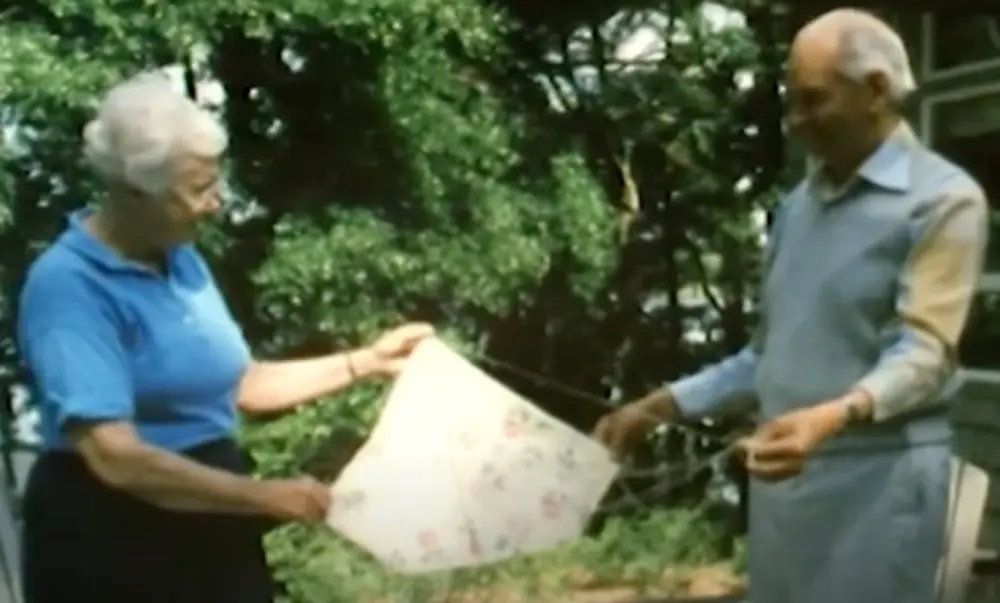
Francis and Gertrude Rogallo are shown holding a curtain kite. Voiceover: “Francis Rogallo’s research on flexible wings began in 1948 with this little model of a kite. His wife Gertrude sewed the original model of our today hang gliders from rest of chintz.” (btm-25)
This curtain kite shown may have some slight similarities to today’s modern hang gliders, but…
The curtain kite shown here is certainly not the one the 1948 patent is based upon. The shape is now pentagonal. It is bi-conical. It bears no resemblance to the patent.
- 1997. A picture shows Rogallo holding the triangular version of the curtain kite.
The Rogallo Foundation caption reads: “July 30, 1997. Francis Rogallo displays his first prototype flexible wing kite created with his wife Gertrude’s old kitchen curtains. On August 15, 1947, the Rogallos flew the kite in a field near their home on LaSalle Avenue, Hampton Avenue.”
August 15, 1948, not 1947 (which would precede Allison !) is the day the Rogallos “reduced to practice” their patented quadrangular bi-cylindrical flexible kite. Now, the Rogallo Founda-tion claims that the curtain kite, triangular and bi-conical, was flown the same day.
More comments
NASA started researching the parasail in 1961. Two years later, Rogallo changed his narrative, claiming the gliding parachute was one of his 1948 designs.
His gliding parachute was first described and pictured in 1974, when Rick Carrier published his Complete Book of Sky Sailing and compared Rogallo to Leonardo da Vinci. Cut from curtain material, it is triangular and glides perfectly. Sixteen years later, when DHV films “the inventor of hang gliding and paragliding”, Gertrude and Francis Rogallo show a different curtain kite, now pentagonal. Then, seven years later, Rogallo goes back to the triangular version.
There could have been a prototype made of cloth during the development of the kite that the Rogallos patented in 1948, but we find it difficult to believe that the two curtain kites, first shown in 1974 and 1990, existed in 1948. There is certainly no proof.
Why did the Rogallos patent the bi-cylindrical quadrangular kite, if they had a much better design: the triangular bi-conical one?
The tale of the curtain kite, from nonexistent to discarded gliding parachute, to “darned successful model” that convinced NASA and was the template of the modern hang glider, is too convenient and too illogical to be accepted in the absence of evidence.
As the patented kite and the Flexikite didn’t look remotely like parawings and parasails, and didn’t look like a modern hang glider, Gertrude and Francis Rogallo had to change their story and promote the curtain kites as the centerpiece of their claimed “inventions”.