
Building the MythIn America
In the American media, both hang gliding and the modern hang glider were presented as having been invented in the USA. The magazines relied on the stories they were told. They were never told the truth, and they never questioned what they were told.
We would expect due diligence from book authors. They were specialists; they had the time to research the subject and to examine the evidence. But they didn’t even study the Rogallos’ first Flexible Kite patent; they just published the patent diagram and implied that it was proof of the story. Everybody had seen the uncontrollable hang gliders that could only skim the ground turn into high-flying, easily controlled, and comfortable-to-fly aircraft. They didn’t bother to find out where it came from. It was all due to Dickenson’s structure and control system, but the best those few who mentioned him could come up with was that John Dickenson, aka Dr. Cyclops, had added the triangular control bar to the Rogallo wing.
The Low & Slow newsletter is important because it was the foundation of the USA’s hang gliding magazines. It was contributed to by pilots for 36 issues, and it lasted over four years. Sadly, its editorial standards went from average to poor, and many of the lies that formed the published history of modern hang gliding can be traced back to it.
Both Bill Moyes and Bill Bennett, who each claimed many times that they invented the Dickenson Glider, were happy to have Rogallo claiming that he invented everything: it helped them obscure John Dickenson’s role.
In May 1971, the Great Universal Hang Glider Championships were held and were later acclaimed as marking the birth of hang gliding as a worldwide sport, although it looked like a crash-in more than a fly-in. Most flights were tow-assisted launches, and they very rarely, and only briefly, escaped from ground effect. Compared to Lilienthal’s flights, it was a massive step backward and marked the end of traditional hang gliding, which was about to be obliterated by modern hang gliding.
All these played a crucial role in building the Rogallo myth.
Some people did not contribute to the myth: the water skiers, for example, who adopted the Dickenson wing without ever referring to Rogallo. They called it the Delta Kite, and until Low & Slow published Dave Kilbourne’s plans, this was what it was always called.
Magazines
It would be repetitive and tedious to underline the approximations and fallacies of each of these articles. Journalists never took the time to research or even simply cross-check.
Some of our favourite gems… The kite was designed in the 1930s as a Mars re-entry vehicle. The wing was developed for possible use as a means of carrying parachuting fighter pilots safely away from enemy territory. The first successful flights were made in 1966 by soldiers who jumped out of planes and circled the ground like gulls. The hang glider is a mix of Miller’s and da Vinci’s ideas. And of Rogallo’s, who invented it all. (btm-04)
- Science & Mechanics – December 1971
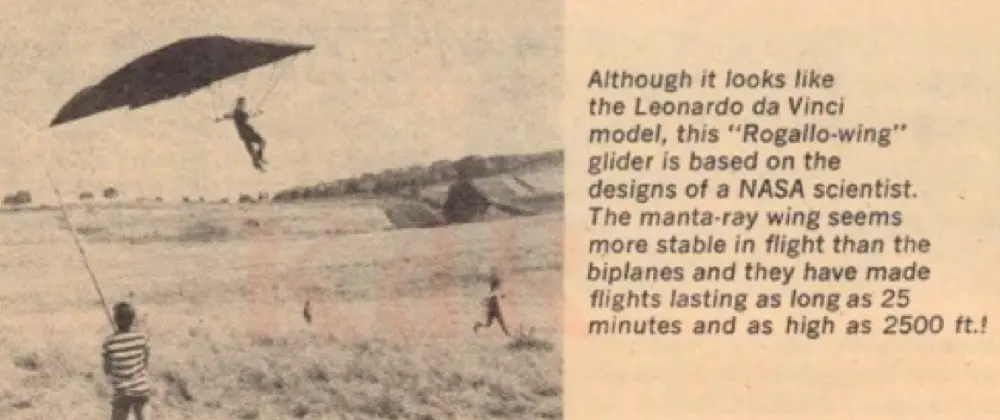
“Hang gliders fall in two categories: straight wings or Rogallo wings. Although it looks like the Leonardo da Vinci model, the Rogallo-wing glider is based on the designs of a NASA scientist, created and tested by Francis M. Rogallo. Richard Miller of San Clemente, California, is generally credited with reviving hang gliders in space-age fashion.”
- True – May 1972
“The man who invented the flexible kite is Francis Rogallo of Warwick, Virginia, an aeronautical engineer who recently retired from the National Aeronautics and Space Administration. Rogallo was not the first to test his kite with a man attached to it. The first successful manned flexible-kite flights were made in 1966 by a few soldiers who jumped out of planes over Fort Bragg, North Carolina, and circled to the ground like gulls.”
- Popular Mechanics – June 1972
“A hang glider is a kitelike wing consisting of a lightweight frame of aluminium or bamboo poles covered with polyethylene plastic or dacron for a skin. It is pilot-carriable and pilot-laun-chable. If it requires any type of towing device, it is not a true hang glider. There are a number of different models, some relatively simple, and others extremely complicated. Thus far, the most popular type is the Rogallo Wing, developed by Francis Rogallo of NASA for possible use as a means of carrying parachuting fighter pilots safely away from enemy territory.”
- Popular Science – June 1972
“Named for NASA scientist Francis M. Rogallo, inventor of this delta wing kite, the basic Rogallo (there are many variations) consists of two leading-edge spars set at 45 degrees to the longitudinal keel; a crossbar and rigging wires hold things together; the sail, usually made of plastic sheet, is attached to the framework of this kite. Credit for introducing the Rogallo system to the hang-gliding fraternity probably belongs to Richard Miller.”
- Gallery – December 1972
“The delta-shaped wing that makes it all possible is something of an aeronautical miracle. It is correctly called a “Rogallo-type flexible wing,“ named after NASA wind tunnel director Francis
Rogallo. In the early ’60s, Rogallo’s ‘flexible wing’ caught the attention of Richard Miller. (He) combined Rogallo’s ideas with some things sketched by Leonardo De Vinci in 1503 A.D. and a few ideas of his own. The result was a Rogallo-type hang glider. It was Miller, flying his own hang gliders at Torrence Beach, with friends, that set off the skysurfing craze early in 1971.”
- Air Progress – January 1973
“Dissatisfied with conventional parachutes’ lack of manoeuvrability, Dr. Rogallo modified the parachute in such a way that it generated forward movement as well as lift. It isn’t known why his invention wasn’t adopted by NASA, but it has become one of the most popular hang-glider designs, primarily because of its simplicity, portability and low cost.”
- Lifestyle – February 1973
“In 1962, Miller first learned of a new wing/kite concept developed by Francis Rogallo of the National Aeronautics and Space Administration, and saw its potential as a simple, inex-pensive, fly-for-fun type of glider. Over a period of two years, Miller built his first Rogallo wing hang glider.”
- Pilot – April 1973
“There are two general types of hang gliders: semi-rigid parasails of the Rogallo genre, and rigid aircraft. The former, developed from designs laid down in the early ‘60s by NASA scientist Dr. F. M. Rogallo as a proposed recovery system for Apollo spacecraft, offers the advantage of low cost and ease of construction, simplicity, portability, and airworthiness.”
- Sport Aviation – April 1973
“Thanks to NASA scientist Dr. F. M. Rogallo and his celebrated ‘kites’, new interest has been focused on hang-gliding. Some remarkable flights have been made at the California sites, Cypress Gardens and elsewhere in the past two years and the manufacture of Rogallo wings is a burgeoning business.”
- Venus – November 1973
“The modern history of the wing (or kite) used in hang gliding dates back to the thirties when Dr. Francis M. Rogallo designed a kite as a Mars re-entry vehicle for NASA.”
- Sport Illustrated – December 1973
“The machines the new aviators fly are variously called hang gliders, kites, sails, delta wings and Rogallo wings. They look like kites and resemble sails in stress and structure but are really neither. They more nearly approximate the delta wings of supersonic craft. Most commonly – and deservedly – they are called Rogallo wings in honour of Francis Rogallo, the Stanford graduate engineer who invented and developed them.”
Books
For many years, the name of Dickenson very seldom appeared in any book, and then only as a sidekick. Nobody credited him with the simplified structure and control system that made the modern hang glider such a resounding success. (btm-05)
In 2007, John Dickenson was shown these books by Graeme Henderson, who pointed out that not one of them mentioned his name and that modern hang gliders were called Rogallos. How did he feel about that?
After a long silence, John answered: “I am definitely disappointed. The picture that you show me here, the same as this one, is quite clearly my wing. Identical in fact to the one Rod Fuller first flew in 1963. The fact that my name, by one means or another, has not been apparent in any of these things is really, you know, an injustice.”
- The Basic Book of Skysurfing – Dan Poynter – 1973
“Francis M. Rogallo has carved his niche in the annals of hang gliding not as a pilot but because his kite has been adapted and is the most popular form of hang glider seen today… The modern sport of hang gliding, particularly with Rogallo, was reborn in 1964 and credit goes to Richard Miller.” In the 1974 fourth printing of the book, John Dickenson’s name is included in an incorrect and insulting account: “Also in ’64, John Dickenson, a water skier/engineer known as ‘the father of kiting’ was the first to put down his flat kite and try a Rogallo”. Dickenson never flew a flat kite.
- The Complete Book of Sky Sailing – Rick Carrier – 1974
“From 1958 to 1972, NASA and their contractors and the Department of Defense spent over 100 million dollars on the application of the Rogallo’s flexible wing invention. With the go-vernment spending a fortune on research and development, it wasn’t long before news of the radically new wing concept leaked out. Versions of the Rogallos’ flexible wing began to appear on the market place. Once the flexible wing formula was released to the public by NASA, the adventurers who wanted to fly quickly scaled down the government’s findings to the smaller size that we see today. A new era of manned flight was born.”
On the inside front dust jacket is this endorsement from Rogallo:
I’ve watched hundreds of flights and it’s still a thrill every time I see a kite take off and land. This book brings it all back- the marvelous pictures and captions are a story in themselves… It covers all the territory and subjects you need to know. A great help for anyone who wants to learn to fly safely. Francis M. Rogallo, inventor of the original flexible-wing sky sail.
[/em]Carrier refers to Rogallo as Dr Rogallo in the book, and Rogallo does not correct him when he has the opportunity.
- The Complete Book of Hang Gliding – D. S. Halacy, Jr. – 1975
“The first Rogallo kite was diamond-shaped and composed of a keel loosely covered with material. The craft was cheap and simple, and NASA became interested in this floppy piece of cloth or plastic that functioned like a wing. It was also practically foolproof. The Ryan Aeronautical Company soon built a Rogallo airplane, which went darting about the skies, and the future for the inventor and his simple kite looked booming. But fate was to have it otherwise, and none of the promising applications proposed for the new wing proved practical. Yet, the Rogallo lives on, in the thousands, as the most popular and certainly the cheapest hang glider that can be built. This happened because at about the time the Rogallos were receiving their belated award from NASA, a dreamer from California, Dick Miller, was beginning to think about a new kind of hang glider.”
- The Complete Beginner’s Guide to Soaring and Hang Gliding – Norman Richards – 1976
“The Rogallo glider provided the breakthrough that made hang gliding possible for masses of people. This triangular kite was developed by a space scientist, Francis M. Rogallo, and his wife, Gertrude, in 1951. It was refined and tested exhaustively by Rogallo for the NASA. People interested in aerodynamic saw possibilities in the kite as a glider, and it was soon modified by a number of manufacturers as well as do-it-yourself builders. Today, more than 90% of the hang gliders being flown in this country are based on the original Rogallo design.”
Low & Slow
In the late 1960s, Low Slow and Out of Control was a newsletter published by Robert B. Wister: “My recollection is some 40 subscribers on the list for $3 per year to cover postage.” The newsletter lasted for six issues. Joe Faust resurrected it from March 1971 to mid-1974 as Low & Slow. (btm-06)
In the 36 issues of Low & Slow, John Dickenson was not named once.
Low & Slow was central in the development of two myths: that Rogallo invented the rigid-framed bi-conical membrane wing, and that the fly-in/crash-in of the Lilienthal Meet was the beginning of hang gliding. Low & Slow concealed John Dickenson just like Rogallo did.
When John Dickenson was awarded the FAI Gold Air Medal for the invention of the modern hang glider in 2012, Faust vehemently disputed on forums that Dickenson had invented anything, calling his Ski Kite “a disaster for hang gliding; it was regressive and had to be ignored in safe hang gliding.” Faust was talking about the gliders that, by the time Low & Slow was published, had carried out thousands of flights, towed, towed and released, dropped from balloons, free flown from mountains, and soared on bluffs. (Ron Nickel, who bought the first glider that Dickenson sold, flew it professionally for a few thousand demonstration flights between 1964 and 1972.)
Joe Faust has to shoulder much of the responsibility for the nonsense that has, until now, passed for hang gliding history.
- 1971
In issue #1, Low & Slow lists the topics it will deal with: a 158-item list with four bullet points on Rogallo, one on Jalbert and none on Dickenson.
Issue #4 presents the “Rogallo Wing Hang Glider”. Stating that Rogallo was the inventor, and that Richard Miller “resurrected not only the hang glider idea, but also the space age configuration”. The pilot is hanging by his armpits in a cage. A double page shows 23 pictures of how the glider is transported and set up. The pilot runs and flies away from a mountain.
In issue #6, under the title “Innovation”, Dave Kilbourne presents “my Rogallo”, his “own design”, and its “very sensitive” control system. The earlier gliders that he flew “were designed by Bill Bennett and built by me”. He announces 1,000 flights, the highest at 760 feet AGL, the longest a 25-minute ridge soaring flight.
Dave Kilbourne’s “Rogallo” is in fact the Dickenson Glider with its innovative control system.
Issue #7 publishes a letter from Francis M. Rogallo, enclosing a check for 12 issues, and announcing his retirement.
- 1972
In Issue #11: “Thanks go to Bill Bennett and Bill Moyes, the two famed professional Rogallo flyers and manufacturers, for coming to the Pro-Am Fly-in at Torrance, California.”
Issue #13 published the Kilbo-Plan: “Thank you to Dave Kilbourne for sharing self-soaringly his complete detailed plan. Dave is selling full-size blueprint-style plans of the same wing”. On one page of the plan is printed: “Design adapted from NASA by Dave Kilbourne.” And on all pages: “Rogallo Wing Hang Glider”. (btm-07)
The plans have nothing to do with Rogallo’s kite, nor with the parawings developed by NASA in the 1960s. It is a copy of the Dickenson Glider. The publication of these lies is a pivotal moment in building the myth that the Dickenson hang glider is a Rogallo hang glider.
A few weeks later, Rogallo will return the favour of being credited by Kilbourne: in his last presentation for NASA (1972 – Flexible Wings for Transportation), he will show pictures of a Dickenson hang glider and credit Kilbourne as the pilot, Low & Slow for the photos, and “B. H. Palmer and others” for having made such wings, and glided down the California hills, ignoring Dickenson.
Issue #16 is a reprint of Rogallo’s last presentation for NASA. Low & Slow is returning the favour of having been referred to by Rogallo in his presentation.
- 1973
Issue #22 stars Bill Moyes, “by far the most experienced and noteworthy Rogallo flying human in the world… Moyes’ wing was copied for plans by many of the ‘pioneers’ of the Rogallo manufacturing movement.”
Not a word on John Dickenson, who had advised Moyes on model design until 1973.
Issue #23 shows a “1904 open-centre twin keel French Rogallo” and “an early twin-wing Rogallo”. (btm-08)
It’s Jan Lavezzari flying off the dunes of Berck and Reinhold Platz wing, designed and flown in the 1920s. Calling a 1904 glider a Rogallo (Francis was born in 1912) shows a pathetic and absurd lack of perspective. The same can be said for Platz. For Low & Slow, everything has to be Rogallo. Historic reality, just like Dickenson, is not to be found in Low & Slow.
- 1974
Issue #33 publishes the first page of the patent filed by Bill Bennet in 1969 and granted in July 1972. (pin-29)
Issue #34 says that the Self-Soar Association (founded by the editor of Low & Slow) “is now reviewing the possibility of retailing Bill Bennett’s Rogallo plan under a new category of presentation”.
Hang Glider Business Weekly
In June 1973, Joe Faust started the Hang Glider Business Weekly. It became the Hang Glider Weekly in September 1973, then Hang Glider in May 1976.
John Dickenson was named for the first time in August 1974. He is the “inventor from Australia who developed the triangular control bar for the Rogallo hang glider”.
In the 232 issues covering eight years, John Dickenson’s name appears six times, and Rogallo’s 1,344 times.
Otto History
In the 1970s, Joe Faust published many messages, promotional sheets, catalogs, etc. They were sent to a large mailing list to build membership in his national hang gliding association and to promote sales of his magazines and various other products. In an undated Otto History, he states that Rogallo could not “validly be held as the inventor of what we see today as the delta wing or flexible sailed ‘Rogallo’ hang glider”. That “skeletonized forms” of “delta-shaped boomed or unboomed canopies… certainly appeared before Rogallo’s development of the all-flexible lifting canopies”.
So, Faust has looked at the Rogallos’ Flexible Kite patent, and knows that Rogallo has invented nothing close to the modern hang glider, still he is happy that Rogallo’s name is given to “the triangle wing… not invented by (him)”, and to the “many NASA experiments… called Rogallo hybrids”. For Faust claims that who invents doesn’t matter as much as who gives “life”, and that “Mr. Rogallo gave lively enthusiasm to the ideas of light-framed and even all-flexible wing aircraft”. Hence, even the 1904 French “rigid-boomed flexible sails self-launched hang glider” can be called Rogallos.
The problem is: Faust is blinded by his “enthusiasm” for Rogallo, and the whole document is full of approximations and fallacies, especially his description of how Rogallo “gave life” to the hang glider: his 1948 kite could not glide or be motorized; NACA did not show interest in the all-flexible concept; Dickenson (of whom he had heard a distorted account from Moyes and/or Bennett) “fathered” and sold the “delta kiting” in the early 1960s, not the late ones. And on, and on for more typical hard-to-read Faust waffle, the key point being that he knows and acknowledges the truth, and confesses to the lie. (btm-27)
The Otto Lilienthal Meet
In March 1971, the first issue of Low & Slow announced:“The Great Universal Hang Glider Championships. Happy birthday to our friend: Otto Lilienthal. When? Sunday, May 23, 1971… And maybe warm-ups on Saturday. Where? Capistrano Beach, California. Get your wings ready. There will be a film and a slide show. This happening promises to be very important for the future of hang gliders. L&S wants to encourage creativity in event definition. Jack Lambie suggests contest categories as follows: Best surface painting – Finest and worst workmanship – Most spectacular crashes – Standard Class: no control – Open Class: some controls – Best Hang Loose type – Best original design. Rules will undoubtedly include that a pilot must take off under his own power.”
Three months later, Low & Slow reported: “Never can there be another first modern universal hang glider championship opening to the world, a refreshing renewal of that relentless desire of man. All the purity of intention commensurate with the historic significance of the big event was present.” Almost 100 pilots participated. There were winners in 27 categories.
No Dickenson Glider was reported as being present, although pictures of the meeting say otherwise. (btm-10)
The Lilienthal meet provided a review of the designs of hang gliders at the time; none of them had a future. It was more of a crash-in than a fly-in. The great universal problem was: how do we control it? Rogallo had hidden Dickenson’s brilliant solution to that age-old control problem, and, because of that, pilots were risking no less than their lives.
In the 1920s, hang gliding and gliding meetings frequently brought together dozens of pilots in Germany and France. In August 1922, at Puy-de-Combegrasse, France, they had many successful flights. Francis Chardon cumulated 34 minutes and 15 seconds of flight time, foot-launching from the slopes in his Biplane #16. (doc-20)
In May 1971, in California, at Newport Beach, enthusiasts flying crude gliders, controlled similarly to those at Puy-de-Combegrass, managed a best flight of only 300 meters lasting a mere 15 seconds. The meet was meant to celebrate Otto Lilienthal’s 123rd birthday, but what they claimed was: “On this hill, May 23, 1971, with a gathering of enthusiasts for personal human flight, began the worldwide sport of hang gliding”. In reality, it marked the end of traditional hang gliding; modern hang gliding was already way ahead of anything they even dreamed about. But they did manage to show how incredible Lilienthal’s flights were compared to the ground-skimming and crashing display they put on.
The “enthusiasts” lacked any sense of history and reality. How could these people who believed that the number one rule of hang gliding was to “never go higher than you are willing to fall”, pretend that they gave birth to hang gliding? What did they think Lilienthal was doing? What about all the flying meets in Germany and France? How could they claim to be the start of hang gliding? By the time of the Lilienthal Meet, pilots in Australia had flown thousands of flights. In the USA, Bill Moyes had flown into the Grand Canyon, and Jeff Jobe was appearing in magazines launching off mountains in Washington, Colorado, and Idaho, all distance flying. All on Dickenson Gliders.
National Geographic
Eight months later, National Geographic published a seven-page article by Russell Hawkes: Happy Birthday, Otto Lilienthal ! (btm-11) A few excerpts…
“Get off the ground at all in a hang glider is something of an achievement… Four young aeronauts from John Muir High School in Pasadena have been the heroes of the day. They have each stayed aloft in free flight for a quarter of a minute and covered distances of 300 feet or more… Richard Miller glided for 280 feet in 12 seconds, the longest flight that day without the help of a towing team… Number one rule of the sport is: Never go higher than you are willing to fall…”
Russell Hawkes was encouraged to fly. He took off, tried to turn into the wind, forgot to flare out, and crashed. (Russell Hawkes was a writer for Aviation Week & Space Technology who reported extensively on the “Rogallo wings” in the early 1960s.)
Today, the hill where the event took place is covered with houses. As close as possible to it, a bench has been erected on which is engraved: “On this hill, May 23, 1971, with a gathering of enthusiasts for personal human flight, began the worldwide sport of hang gliding. May the lift be good and may the joyful spirit of that magical day soar forever.”
In his National Geographic article, Russel Hawkes had concluded: “Days later I’m still pondering. What does Otto’s birthday party signify? Is it one more rash of the endemic madness that periodically breaks out in California? Or the birth of a genuine national leisure-time mania, like drag racing and surfing? Hang gliding, like those sports, involves calculable hazard to life and limb. Flying a frail contraption of bamboo and baling wire cannot be undertaken casually. A dozen and a half gliders, fifty pilots, a thousand spectators at the birthday party don’t constitute a ground swell of mass enthusiasm.
But for all of them to come together at one time and place, with almost no organisation, suggests that larger numbers must be lurking in the hinterlands, leaping off hill sides when no one is looking.”
So much for the claim that the Great Universal Hang Glider Championships were the beginning of the worldwide sport of hang gliding.
The Water Skier
While they were inventing the worldwide sport of hang gliding by flying no higher than they were willing to fall, hang glider pilots forgot to look in their backyard and see what was happe-ning in the sport that had brought the Dickenson Glider to the world: water skiing. (btm-12)
In 1967, The Water Skier, “official publication of the American Water Ski Association”, published the first “drawing of the kite which may take Aussie flyer 1,000 feet into the air”.
In January 1970, Bill Bennett was shown “entertaining crowds at the National Championship with his Delta Wing free-fall flying. By the end of the year, Bennett was advertising for his “revolutionary design featuring stability, control, and safety factors never before available to this thrilling and exciting sport”.
In February 1971, Bill Moyes described his flight into the Grand Canyon in great detail: a 4,800-foot descent over 4.7 miles in 8 minutes and 32 seconds, on a Dickenson Kite with 16 foot leading edges, a 15 foot keel, and a 96 degree nose angle.
In April 1971, Dick Robbins, a Northwest Airlines captain, was reported setting an American record for tow and release: 25 minutes to reach 2,120 feet, 1 minute 35 seconds to fly down. He knew his Delta Wing perfectly, having flown 200 hours with it on Lake Owasso, Minnesota.
Not once did The Water Skier refer to the Dickenson Glider as a Rogallo Wing.
Not once did The Water Skier refer to the Dickenson Glider as a Rogallo Wing.