
Deconstructing the Rogallo MythBefore NASA
There were many inventors, builders, and pilots before the Rogallos had visions of free-flying or parachuting. Some died in their efforts to fulfill their dream. All heavier-than-air aviation began with Otto Lilienthal, the true inventor of the first airplane. Lilienthal used foot-launched hang gliders. In those days, there were two forms of aviation: Lilienthal’s hang gliders and balloons. Later, there were more hang gliders, gliders, powered aircraft, parachutes, jet aircraft, helicopters, rockets, and in 1963, modern hang gliders. These were followed by powered modern hang gliders, paragliders, and paramotors.
The first half of the 20th century was marked by research on the bi-conical wings and gliding parachutes. Many patents testify to their development. The first half of the 20th century was also marked by non-motorised glider meetings, where pilots towed or foot-launched their gliders from mountainsides and free-flew for minutes over hundreds of meters. Eventually, with better control systems, gliders (sailplanes) separated from hang gliders. Hang gliders remained the province of short, low flights with little comfort and no opportunity to exploit lift; meanwhile, sailplanes began ridge and thermal soaring flights, gaining thousands of feet in altitude, until they needed to carry oxygen, and flying ever-increasing distances, now measuring over 3,000 kilometres.
With the invention of the modern hang glider in 1963, hang gliding began to follow the path of the sailplanes, but on a much humbler scale.
Where do the Rogallos fit in the story of the modern hang glider? They don’t. They got into it by lying about their role in the invention of the Dickenson Glider. That story, told honestly, doesn’t have to mention the Rogallos, except to explain the confusion.
Early Rigid-Framed Membrane Man-Carrying Gliders
In the early 20th century, Jan Lavezzari (1904) and Reinhold Platz (mid-1920s) towed and free-flew rigid-framed membrane gliders of elegant designs. They could be packed and stored easily like the modern hang gliders.
Early Rigid-Framed Bi-Conical Delta Wings
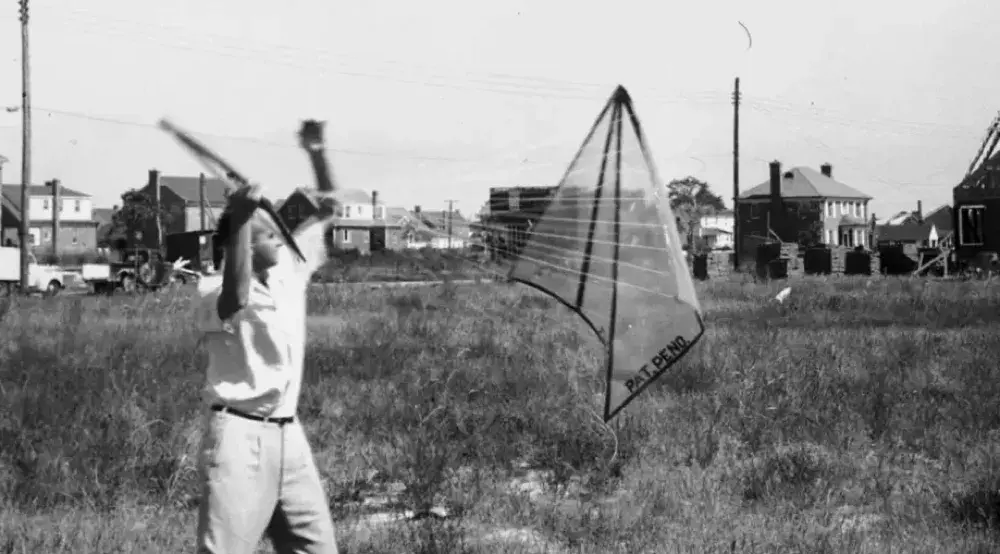
Neither Rogallo nor NASA invented the rigid-framed bi-conical delta wings. For “flying machines” or for “kites”. Many patents were filed as early as 1910, with the Lee and Darrah patent, US 989,786. Wilbur Green’s designs in 1953 gave birth to the Gayla kite series, one of the most popular today.
The First Patent: A Flexible Kite That Could Not Fly
The Rogallos’ first patented “Flexible Kite” was quadrangular and bi-cylindrical. We have no picture of it, static or in flight. Models were built half a century later, based on the patent illustrations and description; they were difficult to fly and performed poorly.
The Second Patent: To Contest Allison’s Patent
The Rogallos filed their second “Flexible Kite” patent two years after William Allison had filed his patent for a “Flexible Kite” (later known as the “Sled Kite”, sold by the hundreds of thousands). The Rogallos applied for the second patent to extend the claims of their first patent to include a single-arch design. They had no aspirations to market the design; there is no evidence that they ever flew one, and the patent was purely a legal maneuver to block Allison’s patent. They wanted to be the sole owners of the “Flexible Kite” appellation. They asked the Bureau of Patents to decide who was the original inventor of the Flexible Kite. To support their claim, which was based on their first Flexible Kite patent, they claimed that their new patent was reduced to practice on the same day as the first patent, in August 1948. They lost the interference case and conceded that Allison had the priority of invention, Allison having “reduced his kite to practice” in September 1947.
William Allison, not Rogallo, is the Inventor of the First Flexible Wing
In April 1955, the Rogallos’, in an affidavit, acknowledged that Allison was “the original and true first inventor” of the Flexible Kite. They hid that fact for the rest of their lives. The world never knew that they had lost the interference case with Allison. They went on to claim that they were the inventors of the first flexible kite, flexible wing, and the “flexible wing concept”, using these terms interchangeably.
From Bi-Cylindrical to Bi-Conical
Some claim that Rogallo’s first bi-conical Flexikite was made in late 1948, at the same time as his bi-cylindrical flexible kite. There is no proof of this. The first photo and description of the Flexikite was published in 1951. Rogallo’s first application for a flexible kite patent was rejected in 1949 due to a perceived conflict with five patents, including Bach’s bi-conical Flying Flexible Wing Kite. The Flexikite series is aerodynamically a low aspect-ratio Bach Flying Wing kite. The similarity with the Wanner kite design, a patent filed in January 1948, is also notable.
The Flexikites Could Not Be Patented…
The Flexikites came in different shapes: quadrangular or hexagonal, bi-conical or bi-cylindrical. Some were printed Patent Pending. We are not aware if patents were filed. If they were, none were ever granted. The bi-conical design was already widely patented by others.
… But They Were Labelled as Patented
Some commercialised Flexikites were labelled as manufactured under three different patents, none of which applied to the Flexikites.
At NACA: Testing the Designs of Others
From 1936 to 1958, Francis Rogallo was a NACA employee in Langley, Virginia, starting as a junior aeronautical engineer, then as the assistant head, then as the head of the 7 by 10-foot Tunnels Branch. As such, he was testing devices designed by others. In his 22 years at NACA, he came up with one patent for parts for jet aircraft wings.
Rogallo stated that his research on flexible wings did not interest NACA, but that NACA allowed him to pursue his work in his own time. At other times, he also said the opposite: that NACA was interested and had begun “some research along this line”.