
Deconstructing the Rogallo MythAt NASA
In 1958, after the Sputnik flights, NACA became NASA. Langley became part of a much larger and different enterprise. It took two years and many meetings for NASA to approve the Paraglider Development Program. It was a complex project involving many research groups from both the government and the private sector. It took two years and many meetings to convince NASA. Giving credit for the Program to Rogallo, with or without the support of Werner von Braun, is an extravagant exaggeration.
At NASA: Testing the Designs of Others
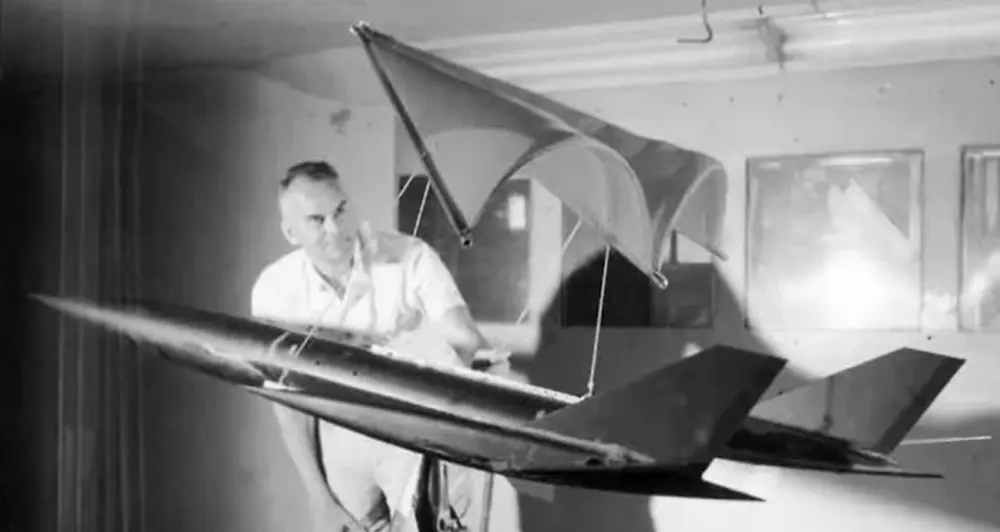
Once the Paraglider Development Program commenced, it was developed by NASA, separately by the Defense Department, and by private contractors. At NASA, Rogallo kept his NACA position at the Langley Tunnels Branch, mostly testing models designed by others. Langley conducted the tests, but research and development were conducted in California for the NASA, Ryan Aircraft, and North American Aviation parawings; in Texas for the NASA Manned Spacecraft Center parasails; and in Missouri for the McDonnell Aircraft Corporation parasails.
The Parawings Were Not Flexible Wings
The Paraglider Development Program first researched the parawings. None of the parawings were flexible wings like the Rogallos’ kites. They were membranes rigidified by inflatable tubes or metallic structures. They were the evolution of the many patented bi-conical rigid-framed wings or kites. Claiming that the parawings were flexible wings is a fallacy. People still refer to modern hang gliders as flexible wings, proving that fallacies are difficult to undo.
The Fleeps Were Not Rogallo Wings
In 1961 and 1962, the Ryan Aeronautical Company “Fleeps” were the most visible of the Paraglider Development Program designs, shown in many magazines. When T. Claude Ryan and Cecil Craigo, his project engineer, were asked where their inspiration came from, they cited Leonardo da Vinci and Otto Lilienthal, not Rogallo. We found nine patents from assignors for Ryan, none of them citing Rogallo in the references.
The Parasails Were Not Rogallo Wings
The Paraglider Development Program also researched parasails. The parasails were flexible wings, but none were the evolution of the Rogallos’ kites.
- Multi-lobbed, they were the evolution of the gliding parachutes, patented as early as 1924.
- Ram-air multi-cell wings were Domina Jalbert’s invention, which came to dominate skydiving in the 1970s and evolved into paragliders in the 1980s.
Claiming that the parasails were Rogallos’ legacy is provably wrong.
Two Patents for Parasails
Rogallo filed a parasail patent for how to control the parasail by changing the surface shape of the wing, and one for a new configuration to inflate ram-air cells. We don’t know if these patents were used. They have nothing to do with today’s wings.
Rogallo’s Deceptions
In many documents, Rogallo stated that his first flexible kite patent (1948) was not limited to his claims (quadrangular, bi-cylindrical). What was important was his vision. His vision extended to any shape, size, or purpose (aircraft, glider, cargo, or man-carrying wings…). In his only NACA presentation (1954), he extended his visions to flying automobiles and flapping-wing aircraft. Later, he included the multi-cell ram-air parachute and paraglider wing. When Rogallo claimed that his vision made him the inventor, he was deluding himself and deceiving everyone.
Rogallo’s Lies
In 1962, in a Technical note, Rogallo misled NASA by claiming that everything in the Paraglider Development Program, even “other configurations” being considered, were all “Rogallo Wings” and that the “flexible wing concept” was his invention. When Rogallo distorted reality deliberately like this, we have no choice but to say that he was lying.
$35,000 for Public Relations
NASA’s management did not seem to be aware of, or care about, Rogallo’s flexible wing lie. They swallowed it and, in 1963, they gave the Rogallos a large $35,000 cash award for having allowed NASA to use their two flexible kite patents. A strange justification, as Rogallos’ patents had nothing to do with the parawings and parasails being researched. The only explanation for this largess was to give Rogallo legitimacy as their PR man, as millions of dollars were raised and spent in the Paraglider Development Program.
Seventeen Patents to Launch and Control the Rigid-Framed Delta Wings
Rogallo’s real contribution to the Paraglider Development Program can be demonstrated by examining his 17 patents associated with parawings. They don’t concern the structure or design of the aircraft, but only with how to launch them in space or how to control them in flight. We doubt that any of these patented designs were ever built or used.
Nine Publications: No Lasting Contribution to Existing Knowledge
Rogallo’s contribution to the Paraglider Development Program is shown in his publications. We found:
No Technical reports (“important, complete, and a lasting contribution to existing knowledge”)
Two Technical notes (“of importance as a contribution to existing knowledge”)
Three Technical memorandum (“findings that are preliminary or of specialised interest; does not contain extensive analysis”)
Four Special presentations (“information derived from or of value to NASA activities, including conference proceedings”).
These contributions indicate that Rogallo was not closely involved with the research on parawings and parasails. He reported on what was going on, often in a self-promoting way, allowed and encouraged (the cash award) by management at NASA.
Other NASA Publications: Seldom Cited
Rogallo’s contribution to the Paraglider Development Program can be measured by how rarely he is cited in other NASA publications. We checked the publications Rogallo referred to in a 1972 presentation. Out of 102 referenced documents (over 6,900 pages), The word “Rogallo” appears only four times.
The Dickenson Letters
In September 1964, Rogallo, using the NASA Langley address, contacted John Dickenson after receiving newspaper clips about the first flights of Dickenson’s hang glider in Australia. Dickenson sent Rogallo 10 pages of plans along with two pages of building instructions for the template that was about to be used to build tens of thousands of modern hang gliders. The correspondence lasted until 1970. We found no evidence that Rogallo ever shared Dickenson’s plans with NASA or anyone else. We found no evidence that Dickenson’s plans influenced Rogallo’s research.
Why?
The big questions are… Why Rogallo, who had the plans for the simplest and safest hang glider ever invented, didn’t share them with NASA, with all its human and financial resources? Why did he not share it with the pioneers who contacted him for information in their efforts to build hang gliders? Why did he not make one, or have someone build one for him, the easiest aircraft to copy that had ever been invented? If Rogallo had shared the plans, significant progress in design and safety would have been made for the hang gliders that passionate amateurs were building.
The End of the Paraglider Development Program
By mid-1964, the Paraglider Development Program was finished as far as NASA was concerned. Too many technical and operational problems had run into budgetary dead ends. The program survived a few months for data-gathering purposes, but there was no longer any belief that it could produce a worthwhile result. More than 27 million dollars had been spent. Rogallo and NASA had nothing to show for it.