
At NASA 1964-19721972 — Lies and Illusions
Two years after he left NASA, Francis M. Rogallo, Delvin R. Croom, and William C. Sleeman co-authored a presentation given at the International Congress of Transportation Conferences, May 31 to June 2, 1972, in Washington, DC: Flexible Wings for Transportation. It states that Rogallo is “the senior author of this paper”. (rre-09)
The report is full of approximations. It is Rogallo’s last report for NASA, and as such, worthy of close analysis. Here are some extracts and our comments.
The originators
The originators of the flexible-wing concepts in the late 1940s created a completely flexible lifting surface with a parachute-like tension structure in which the wing surface shape is maintained by the balance of forces between the air load on the surfaces and the tension in the suspension lines, and flexible wings that could have several types of localised stiffening.
Rogallo is talking about his wife and himself, not William Allison, “the original and true inventor” of the flexible kite, as they acknowledged in 1955. The Rogallos’ 1948 patent does not allow the type of “localised stiffening” that Rogallo suggests now, and that will be used systematically by NASA et al. in the parawing series.
All through the presentation, Rogallo will systematically refer to “flexible wings” when, in fact, all parawings were rigid-framed.
[/p]There are many potential uses for flexible wings in astronautics, but the present paper will be limited to their use for transportation of passengers and cargo.
“Potential” is the important word here. Just as in his 1948 flexible kite patent or his first-ever presentation, 1954 Introduction to Aeroflexibility (rre-01), the possibilities are endless. But nothing that was ever tried owes anything to Rogallo’s inventions. And neither the modern hang glider nor the modern paraglider came from Rogallo’s inventions. History proves that all of Rogallo’s concepts and every idea he sold to NASA were a waste of NASA’s money and resources.
These subjects are covered by the technical papers listed in the Appendix.
See the previous sub-chapter, “Rogallo in NASA et al. Publications”, our analysis of the 102 documents listed in the Appendix.
Some additional sources, mostly from recent periodicals, will be given as references for those who wish to search the literature.
We do not doubt that the periodicals that Rogallo referred to presented him as the inventor and father of anything flexible that ever flew. Most publications still do it today. One of the periodicals cited, the Low & Slow newsletter, will call Jan Lavezzari and Reinhold Platz’s flexible gliders, flown successfully in France (1904) and Germany (1920s), “French Rogallo” and “twin-wing Rogallo” (btm-08)
Gliding and Soaring
One of the earliest anticipated uses for flexible wings was gliding from hills or mountains to lower elevations. B. H. Palmer and others made flexible wings and began gliding down the California hills about 10 years ago. This application has recently achieved prominence although it is as yet only in the realm of sport. D. Kilbourne demonstrates one of these hang gliders in Fig. 1.
Palmer did ground-skim in the early 1960s, but his design, lacking a viable control system, was unsafe and had no future. It wasn’t even as good as the other designs that would be flown at the famous 1972 Otto Lilienthal Meet in California. During the previous eight years, when John Dickenson and Francis Rogallo had corresponded about Dickenson’s invention of the modern hang glider, Rogallo was fully aware of the quality and superiority of Dickenson’s design. Dickenson and many others had, by 1972, achieved thousands of flights. Still, Rogallo refuses to name and acknowledge Dickenson.
Ridge-soaring flights of over one hour duration have already been achieved with relatively crude flexible-wing hang gliders.
At the time Rogallo was writing his presentation, hundreds of pilots throughout the world were flying Dickenson hang gliders. Rogallo knew that Bill Moyes and Bill Bennett were using modern hang gliders designed by Dickenson when they stormed through the USA in the late 1960s′ and early 1970s′, flying around the Statue of Liberty and down into the Grand Canyon.
The Dickenson Gliders were not “relatively crude”. They were the perfect coincidence of extreme simplicity, user-friendliness, and copyability. The template for tens of thousands of gliders to come. Rogallo knew it: in a letter to Dickenson dated August 28, 1988, he admitted the superiority of Dickenson’s design over others.
It is anticipated that in the near future flexible-wing gliders will be developed that will be almost as easy to carry and store as a pair of snow skis.
It was already the case with the Dickenson hang glider, and Rogallo knew it.
Towing
Flexible-wing tow gliders for sports purpose were developed about 10 years ago by T. H. Purcell.
The omission, again, of the Dickenson Glider, towed, released, and free-flown since 1963 by hundreds of pilots for leisure, for paid demonstrations and displays, and in large competitions around the world, is staggering.
It was also demonstrated that they could be released at altitude and radio-controlled to chosen landing points.
Rogallo’s omission of the balloon releases and human-controlled flight to chosen landing points by Steve Cohen, Bill Moyes, and Bill Bennet, from as high as 10,000 feet, is in line with his hiding anything related to the Dickenson hang glider.
Powered flight
Rogallo is stuck in a fictional dream. He rehashes his 1949 vision of the flexible-wing flying-automobile, and regrets that the government or the transportation industry is not sponsoring “seriously” research for a “practical solution”.
Aerial dropping – Rocket launched
Rogallo describes American and German research, and success with the experiments. But they will lead to nothing, It’s just his fictional dream: he imagines a flexible-wing-equipped supersonic aircraft (SST), transporting people and cargo: A serious study of this application should be initiated now.
He wants money to finance more and more research in the vain hope that something of some value will be produced.
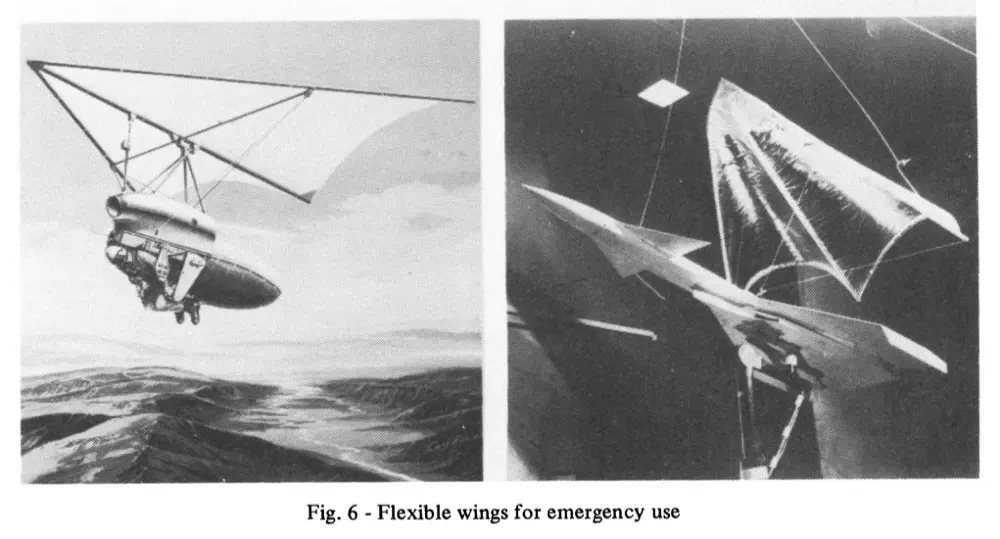
Emergency wings
As a personnel parachute substitute, a flexible wing would provide a controllable gliding capability, allowing the pilot a wide choice of landing.
Rogallo has it almost right. But his illustration of a parawing as a “personnel parachute substitute” has nothing to do with today’s reality. Only the parasail will evolve into a rescue system.
Concluding Remarks
Until now, flexible wings have been used in only a few of the many possible applications discussed in this paper.
This really is an admission of failure. Visions are not reality.
It is our hope that this paper may arouse serious efforts to initiate research and development that could result in other applications that would come into general use.
It will not happen. The modern hang gliders and paragliders have nothing to do with Rogallo’s – “The Originators” –, or NASA’s technology.
Flexible wings have been investigated primarily by NASA and the U.S. Army, but this work was stopped by lack of funds resulting from the national effort to cool the economy.
History points to recessions in the early 1960s, but recessions are not a “national effort to cool the economy”, and in fact, huge sums of money were being spent on space research before, during, and after the Paraglider Development Program “to achieve the goal, before this decade is out, of landing a man on the moon and returning him safely to the earth” as President Kennedy had requested. The work on flexible wings was terminated solely because it was a failure. NASA, the Department of Defense, and their contractors had nothing practical to show, even though $27.4 million had been spent in three years just for Project Gemini (the equivalent of $295 million in 2026). We have not found an evaluation of the money spent on parawings and parasails outside the Gemini Program.
Flexible wing technology is now in search of a serious sponsor, and one or more should come forth to ensure that this technology will go forward and provide the many benefits of which it is capable.
It will not happen. The evolution of the modern hang glider and paraglider will be in the hands of passionate individuals, not free-spending sponsors or administrations, and none of it will be based on Rogallo’s work.