
At NASA 1958-1964The $35,000 Cash Award
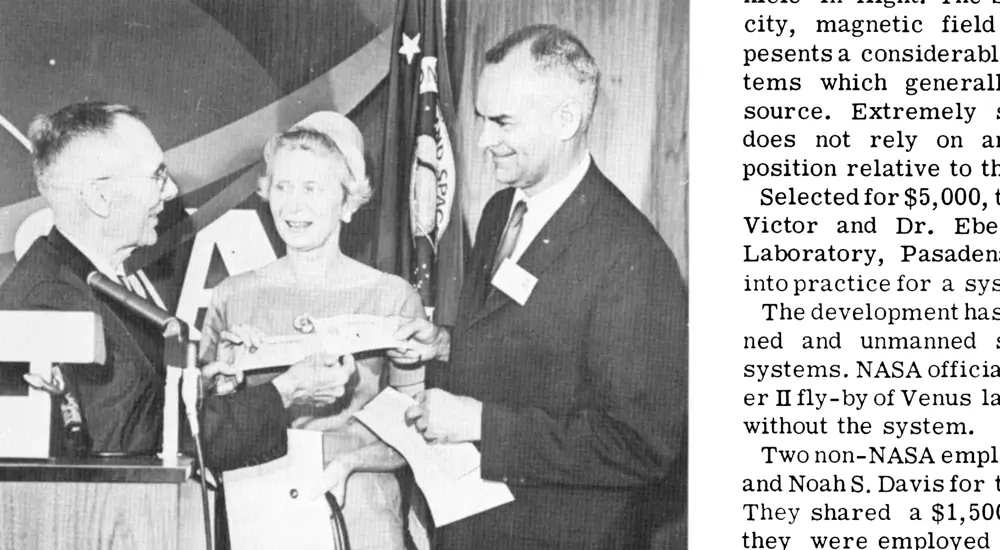
In July 1963, NASA presented the Rogallos with a US$35,000 monetary award. Rogallo commented in his September 1963 presentation Parawing for Astronautics: (rre-06)
By the summer of 1963, it appeared that the concept had achieved world-wide acceptance and that the time had come for (me and Gertrude) to give the government royalty-free license for the use of our patents, which we did in a ceremony in Washington on July 18, 1963.
The Langley NASA Researcher newsletter reported in his August 2, 1963, issue:
“Francis M. Rogallo and his wife, Gertrude S. Rogallo, whose innovations as kite-flying hobbyists sparked the development of paragliders recently received the largest cash award ever made to inventors by NASA. Rogallo, who has been a scientist at the Langley Center since 1936 and is now head of the 7 by 10-foot Tunnels Branch, Full-Scale Research Division, and his wife were presented $35,000 by Dr. Hugh L. Dryden, Deputy Administrator of NASA, in ceremonies at NASA Headquarters on July 17.
‘The Rogallos were selected for their two inventions covering the flexible-wing concept which contributed to the development of flexible wings that can be packaged and deployed. The innovation has led to large-scale development work on paragliders by NASA and the military services. It is estimated that NASA and the Army alone have more than a million dollars involved in these programs. A version of the paraglider is being considered for use as the principal recovery system in later phases of the Gemini Program, which will place two-man spacecraft in earth orbit for periods lasting up to two weeks.
‘The NASA Inventions Board explained that the Rogallos’ award was based in considerable part on the Government’s use of a privately owned invention without any claim for royalties or a request for a license from the inventors. The Rogallos hold two patents, one issued March 20, 1951, and the other June 19, 1956.
‘Dr. Dryden, in his presentation statement, noted that the couple on their own initiative and expense “devised the vehicles, procured patent protection, reduced the invention to practice, and pursued continuous development to perfect the application of the principles involved. The Rogallos’ ideas grew out of their hobby of kite flying. When they first approached Government agencies around 1950, they found no one interested. It was several years later that possible aeronautical and space applications were seriously considered.” (doc-05)
Thirty-five thousand dollars in 1963 is the equivalent of some $380,000 in 2026, which is not a small sum.
The Langley NASA Researcher explained that the award was based partly on the use of a privately owned invention; that the Rogallos’ innovations as kite-flying hobbyists sparked the development of paragliders; that they pursued continuous development to perfect the application of the principles involved. We wonder which innovations and what developments came out of the Rogallos’ flexible kite patents. We found none. Not even the Rogallos used their patents for anything practical.
Ten years later, the Fourth Court of Appeal ruled in Rogallo v. the United States, a suit brought by the Rogallos for a tax refund on the cash award. It stated: “On July 18, 1963, NASA presented the Rogallos with a monetary award having a face amount of $35,000, which, less taxes withheld, was divided equally between them. The award recited that it was made “for the technical contribution entitled ‘flexible kite’ which represents a significant value in the conduct of the aeronautic and space activities of the United States.” The court concluded ”that, in fact and in law, the award was not made primarily in recognition” of their invention of the parawing. NASA made the award not primarily for their act of invention, but for their act of contributing the invention to NASA.
We find it confounding that:
- NASA considered that the rigid-framed parawings it was developing had something to do with Rogallo’s flexible kites, whose patents said clearly that they could not be rigidified except by a crease in the flexible material.
- NASA ignored the fact that William Allison had invented a flexible kite before Rogallo, and had a better claim to be “the original and true inventor” of the flexible kite concept.
- NASA management and public relations people swallowed—hook, line, and sinker—Rogallo’s claim that “Paraglider, Parawing, Flexikite, Flex-wing, Flight-sail, etc.” were Rogallo Wings, even though they bore no resemblance to Rogallo’s flexible kite patents.
As explained in the previous sub-chapter, almost everybody was fooled. We expected more perspicacity from NASA.
Maybe this award was just a show. NASA was heavily involved in a Paraglider Development Program that, over three years, cost the equivalent of 295 million US dollars in 2026 money. The program was struggling, and it had many opponents. It seems that Rogallo was given this award to strengthen his credibility as a Public Relations man so that he could be sent around the country to present and promote NASA’s project, which he did in Ohio, Minnesota, New York, Washington, D.C., and California.