
ClarificationsAbout Patents
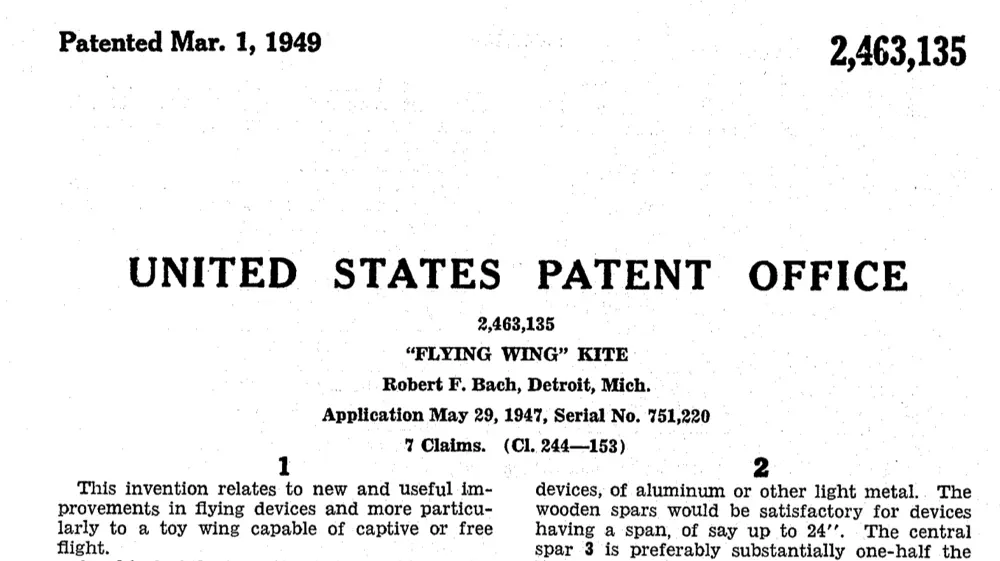
Most patents are presented in pointed lists. We usually include texts from the patents after the patent number.
Patent documents are a unique form of text requiring careful reading. They contain or may contain several sections.
Dates – Most of the time, two dates are shown on the patent: the application date and the approval date. The application date is generally of more relevance from a historical point of view, but the application date is not when the object was invented. As is seen in the interference case between the Rogallos and William Allison (rva-07) etc., the application does not always prove the priority of an invention.
Diagrams – The diagrams are not what is patented but a tool to help explain the invention and how it might work. A patent that is for a cowling, which is intended to streamline an aircraft’s wheel, can include a drawing of an aircraft; however, that does not mean that the aircraft is subject to the patent.
Description – This section explains many details about the invention. The patent may not cover everything in the description.
Claims – The claims are where you find what is being covered by the patent. There can be any number of claims in one patent. Each claim is a separate matter, independent of the other claims.
References – This is the list of patents that were in some way similar enough to the patent that further clarification was required to show the difference between the current patent and the referenced patent. The referenced patents form a fence around the patent, limiting the claims that can be made. You can see how these referenced patents work in the Rogallo and Allison patent interference documents (rva-02) etc.
Reduced to Practice – Unlike in the rest of the world, prior to 2011, the United States operated under a ‘First to Invent’ system, rather than a ‘First to File’ system. If the application date is generally of more relevance from a historical point of view, it is not this date that proves the priority of an invention. Invention legally occurs when the device is “reduced to practice”, a legal term that means the date the device is first built, used as intended, and works as intended. (Such interference proceedings are not found in other jurisdictions and are no longer found in the USA.) A patent may be issued for an inventionthat has not been reduced to practice. The Patent Office relies on the integrity of the applicant for information used in awarding patents. However, in a dispute, if it turns out that a patent has never been reduced to practice, then that patent will have little or no value in the dispute. We do have serious concerns about some of the patents discussed in this book.
Warning – The information in this website does not constitute legal advice. We are not attorneys and do not present ourselves as attorneys. This information is intended only as a guide to help the layperson navigate the topic of patents in the pursuit of the study of history. If you require legal advice regarding patent law, then you must contact a patent attorney in the relevant country.